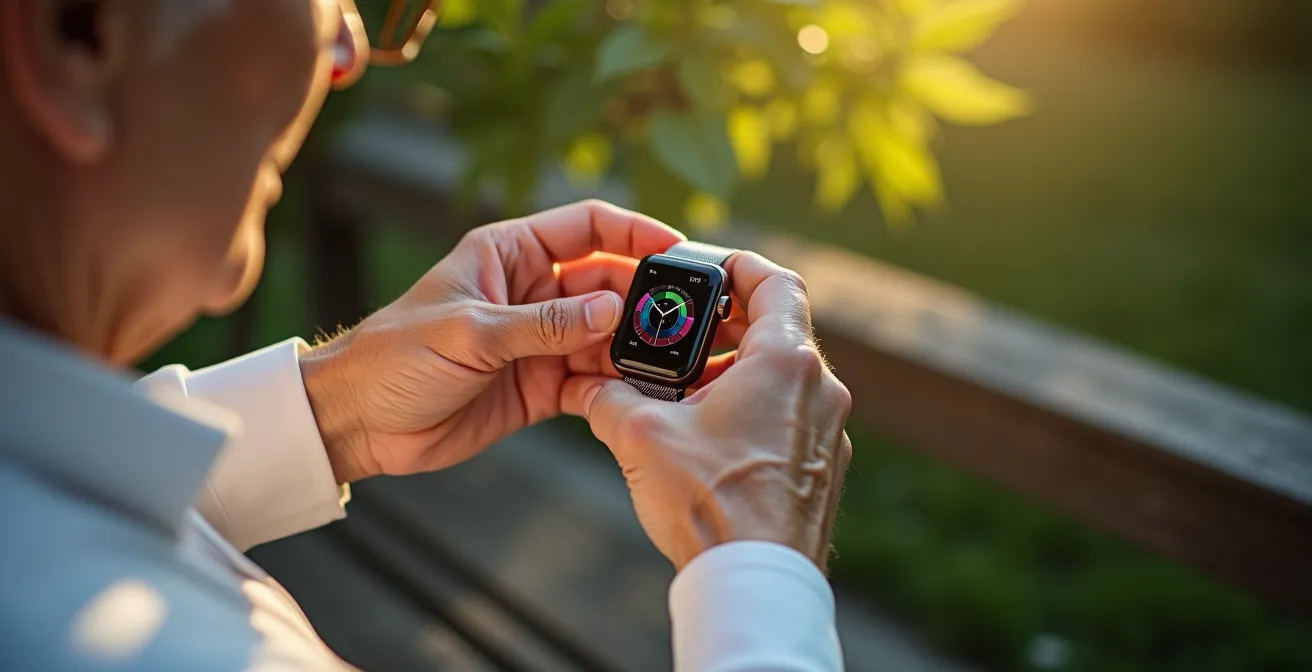
The true value of a wearable device for arrhythmia detection lies not in its passive alerts, but in its ability to generate a continuous, clinically relevant data stream that empowers you and your cardiologist.
- Heart Rate Variability (HRV) measured during sleep is a far more sensitive marker of cardiac stress and autonomic function than simple heart rate.
- Focusing on achieving 150+ minutes of moderate activity is clinically more significant for improving cardiac health in seniors than just tracking daily step count.
Recommendation: Treat your wearable as a “symptom-rhythm correlator” by actively managing, securing, and preparing its data for every medical consultation.
For seniors concerned about the risk of Atrial Fibrillation (Afib), the advent of consumer wearables like the Apple Watch or Oura Ring seems like a breakthrough. The promise is simple: a device that watches over your heart and alerts you to potential danger. While these devices are indeed powerful screening tools, focusing solely on their alert function is a significant underutilization of their capabilities. The common advice is to “share the data with your doctor,” but this often results in presenting a single, isolated ECG strip or a notification event, which provides limited context.
The conversation around wearables often overlooks the deeper, longitudinal data they collect. Metrics like Heart Rate Variability (HRV), activity trends, and sleep patterns offer a rich narrative of your cardiovascular health. The key is to move beyond a reactive stance—waiting for an alert—to a proactive one. This involves understanding which data points truly matter, how to protect this sensitive information, and most importantly, how to organize and present it to transform a routine check-up into a data-driven, collaborative discussion with your cardiologist.
This article re-frames the role of your wearable from a simple arrhythmia detector to an active data-gathering partner. We will explore how to interpret advanced metrics, manage your data securely, and prepare a comprehensive health picture that empowers both you and your clinical team to make more informed decisions about your cardiac health. This is about turning raw data into actionable medical intelligence.
For those who prefer a visual summary, the following video explains how devices like the Apple Watch can accurately detect Afib, providing a great foundation for the data-driven strategies we will discuss.
This guide will provide a structured approach to leveraging your wearable device for proactive heart health management. We will cover the most important metrics to track, how to secure your data, and the practical steps for sharing this information effectively with your healthcare provider.
Summary: A data-driven approach to early arrhythmia detection with wearables
- Why Heart Rate Variability During Sleep Indicates Stress Levels?
- Who Owns Your Health Data: Steps to Secure Wearable Information
- The Risk of Skin Irritation: Choosing Bands for Fragile Skin
- How to Share Apple Watch Reports with Your Cardiologist?
- Steps vs Activity Minutes: Which Metric Matters More for Seniors?
- When to Increase Screening Frequency for Cardiac Issues After 70?
- The Risk of Data Leaks: Securing Cameras and Microphones
- How to Digitize Your Medical Records for Emergency Access?
Why Heart Rate Variability During Sleep Indicates Stress Levels?
While most users focus on resting heart rate, Heart Rate Variability (HRV) is a far more sophisticated and sensitive autonomic marker of your body’s physiological stress. HRV measures the variation in time between each heartbeat, controlled by the autonomic nervous system (ANS). A high HRV generally signifies a well-rested, resilient state, while a low HRV indicates the body is under stress, whether from illness, poor sleep, or emotional strain. During sleep, when external stimuli are minimal, HRV provides a clear window into your body’s recovery and readiness.
The ANS has two branches: the sympathetic (“fight-or-flight”) and parasympathetic (“rest-and-digest”). High stress activates the sympathetic branch, leading to a more regular, metronome-like heartbeat and thus, a lower HRV. Conversely, a relaxed state allows the parasympathetic branch to dominate, resulting in more natural variation and a higher HRV. Chronic stress and poor sleep can suppress parasympathetic activity, leading to persistently low HRV, which is a known risk factor for cardiovascular issues. In fact, some studies show that just 24-hour sleep deprivation increases sympathetic activity by 1.5-2.3 fold, directly impacting this balance.
The sensitivity of HRV as a stress indicator is profound. An 8-week study on police officers using Oura rings demonstrated this clearly. It found that while sleep duration took about 3 days to recover after a stressful event, HRV took a full 6 days to return to baseline. This highlights that HRV can reveal underlying physiological strain long after you feel you’ve “caught up” on sleep. For seniors monitoring cardiac health, tracking the HRV trend over weeks, not days, offers crucial insight into the body’s cumulative stress load, a factor that simple heart rate readings would miss.
Therefore, monitoring your morning HRV score as a baseline is a powerful, proactive strategy. A consistent downward trend can be an early warning sign to consult your physician, even in the absence of an overt arrhythmia alert.
Who Owns Your Health Data: Steps to Secure Wearable Information
As you generate a continuous stream of personal health data, the question of ownership and security becomes paramount. The data collected by most consumer wearables—heart rate, activity levels, sleep patterns—is not automatically protected by the Health Insurance Portability and Accountability Act (HIPAA) in the United States. HIPAA primarily covers data held by healthcare providers, insurers, and their business associates. Your wearable data, stored on the manufacturer’s servers (like Apple, Google, or Oura), exists in a regulatory gray area.
This means you are the primary custodian of your health information. The responsibility falls on you to manage privacy settings, control third-party app access, and practice good data hygiene. While device manufacturers have robust security measures, data can be vulnerable during transmission to your phone, when shared with other apps, or if your accounts are compromised. Understanding these risks is the first step toward building a secure personal health record.
Taking control of your data involves a few non-negotiable security practices. These steps help create a secure digital environment for your health information, ensuring that you, and only those you explicitly authorize, have access to it. It’s about building a digital fortress around your most sensitive information.
Action plan: 5 steps to secure your wearable health data
- Enable multi-factor authentication (MFA) on all connected health apps and accounts to add a critical layer of security beyond a simple password.
- Routinely review and adjust privacy settings within the wearable’s app, specifically opting out of any data sharing with third parties for marketing or research purposes.
- Request and download your data from the provider periodically to maintain a personal backup that you control completely.
- Understand the limits of HIPAA; recognize that most consumer wearable data is not covered and requires your personal vigilance.
- Set up any available breach notification alerts and actively monitor your accounts for unauthorized access attempts or suspicious activity.
Ultimately, treating your wearable data with the same seriousness as your financial information is the new standard. By actively managing your settings and being mindful of how your data is shared, you retain ownership and control over your personal health narrative.
The Risk of Skin Irritation: Choosing Bands for Fragile Skin
While the focus is often on the technology inside the wearable, the physical interface—the watch band—is a critical component for continuous monitoring, especially for seniors with fragile or sensitive skin. Constant contact can lead to contact dermatitis, rashes, or irritation caused by trapped moisture, friction, or an allergic reaction to materials like nickel, which can be found in some metal alloys and dyes. For a device to be worn 24/7 for effective sleep and HRV tracking, comfort and biocompatibility are non-negotiable.
The choice of material is paramount. Standard silicone bands, while durable, can be occlusive, trapping sweat and bacteria, leading to irritation. Materials with better breathability and moisture-wicking properties are often superior for long-term wear. Fabric weaves, nylon sport loops, and certain metals like titanium or ceramic are excellent alternatives. Titanium is particularly noteworthy as it is lightweight, strong, and highly biocompatible, meaning it is very unlikely to cause a skin reaction.
This macro photograph highlights the distinct textures of different band materials, from breathable fabric to smooth silicone and structured titanium mesh, each impacting skin health differently.
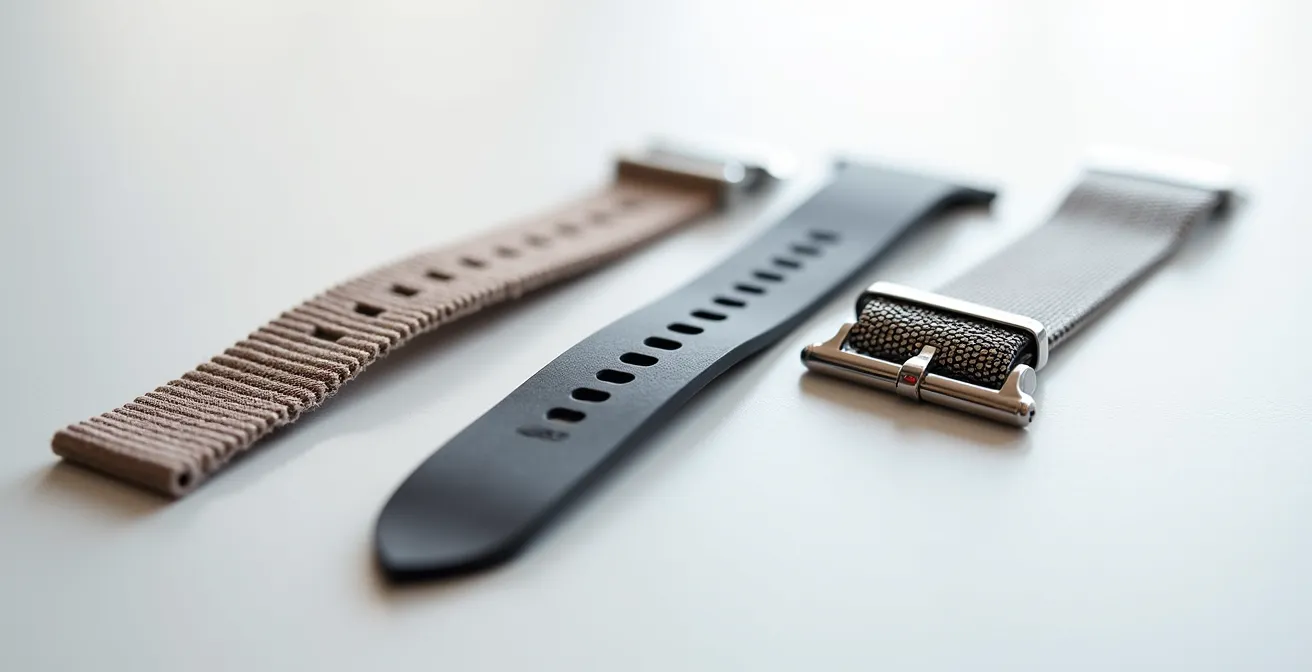
As the image illustrates, the structure of the material directly affects its interaction with the skin. Beyond the material itself, proper fit and hygiene are essential. A band that is too tight can cause friction and restrict blood flow, while a band that is too loose can move around, causing chafing and compromising the accuracy of the heart rate sensors. It’s recommended to regularly remove the watch, clean the band and your skin with a mild, non-soap cleanser, and allow both to dry completely before putting it back on.
The following table provides a clear comparison of common band materials, helping you select the best option for comfort and skin health, which is critical for consistent, long-term health tracking. As this analysis of wearable devices shows, the physical interface is as important as the digital one.
| Material | Breathability | Flexibility | Moisture-Wicking | Cleaning Ease |
|---|---|---|---|---|
| Fabric Weave | Excellent | Good | Excellent | Moderate |
| Nylon Sport | Good | Excellent | Good | Easy |
| Leather | Poor | Moderate | Poor | Difficult |
| Titanium | Good | Poor | N/A | Easy |
| Ceramic | Moderate | Poor | N/A | Easy |
Choosing the right band is not a minor detail; it’s a foundational step to ensure the wearable can be used consistently and comfortably, making the valuable data it collects both reliable and uninterrupted.
How to Share Apple Watch Reports with Your Cardiologist?
Presenting your cardiologist with a single Afib notification is useful, but providing a contextualized data package is transformative. The goal is to move beyond “My watch had an alert” to “Here is my heart rate and HRV trend leading up to, during, and after the symptomatic event I experienced last Tuesday at 2 PM.” This level of detail allows your doctor to correlate your subjective symptoms (like dizziness or palpitations) with objective biometric data. This approach is best described by a leading expert in the field.
As Dr. Steven A. Lubitz of Massachusetts General Hospital Cardiology notes, this reframes the entire purpose of the device. His perspective, shared in a report on a novel algorithm for detecting irregular heartbeats, is crucial:
Framing the wearable not as a diagnostic tool but as a ‘symptom-rhythm correlator’ provides valuable clues that complement clinical assessment
– Dr. Steven A. Lubitz, Massachusetts General Hospital Cardiology
To effectively act as a symptom-rhythm correlator, you must prepare your data ahead of your appointment. Most wearables, including the Apple Watch, allow you to export reports. For an Apple Watch, this involves going into the Health app, navigating to the Heart section, and finding the ECG readings. You can then export each one as a PDF. However, simply exporting the raw data is not enough. The key is annotation and trend analysis.
Your data package for a telehealth or in-person visit should be a curated summary. Create a multi-week HRV trend report from your device’s app to show your baseline versus the days you felt unwell. Export the specific ECG PDFs from the times you experienced symptoms and annotate them with notes about what you were doing and feeling at that moment (e.g., “Felt light-headed after climbing stairs”). Documenting potential triggers like caffeine intake, stressful events, or medication changes alongside these readings provides invaluable context. Prepare specific questions about the data to guide the conversation and ensure your concerns are addressed.
By arriving prepared with this organized, contextualized data package, you elevate the conversation from a simple check-up to a collaborative, data-driven analysis of your cardiac health.
Steps vs Activity Minutes: Which Metric Matters More for Seniors?
For decades, the “10,000 steps a day” goal has been the dominant metric for daily activity. While it’s a simple and motivating target, from a cardiovascular health perspective, it’s an increasingly outdated and imprecise measure, especially for seniors. Recent clinical research indicates that the intensity and duration of activity matter far more than the total volume of steps. For cardiac benefits, focusing on “Activity Minutes”—time spent in moderate-to-vigorous physical activity—is a more clinically relevant goal.
The distinction is critical. Ten thousand steps could be accumulated through slow, intermittent walking throughout the day, which has minimal impact on cardiovascular conditioning. In contrast, 150 minutes of moderate activity per week, often achieved in brisk 10-minute-or-longer bouts, consistently elevates the heart rate, strengthens the heart muscle, and improves autonomic function. This is not just a theoretical difference; it’s backed by data.
A longitudinal study of adults over 65 provided clear evidence. It found that participants who achieved 150 minutes of moderate-to-vigorous activity per week showed a significant improvement in their Heart Rate Variability (an average RMSSD increase of 8ms), which is directly linked to better cardiac autonomic health and reduced arrhythmia risk. In stark contrast, the study found that step count alone showed no significant correlation with these crucial cardiac markers. This proves that for heart health, the quality of your activity trumps the sheer quantity of steps.
Therefore, seniors should shift their focus. The goal is not just to move, but to move with purpose. Start by establishing a baseline of your current activity minutes for one week. Then, aim to incrementally increase your moderate activity by 10 minutes per week until you reach the 150-minute target. Most wearables are adept at tracking this metric, making it easy to monitor your progress toward a goal that has a demonstrable impact on your heart’s health and resilience.
Prioritizing sustained bouts of activity that elevate your heart rate is one of the most powerful lifestyle interventions for improving long-term cardiovascular outcomes.
When to Increase Screening Frequency for Cardiac Issues After 70?
As we age, the risk of developing cardiovascular conditions, particularly Atrial Fibrillation, increases significantly. While a baseline ECG during an annual physical is standard practice, the rationale for more frequent screening after the age of 70 becomes compelling, especially for individuals with risk factors like hypertension or a family history of heart disease. The prevalence of Afib is not linear; it accelerates with age. This makes passive, continuous monitoring with a wearable a logical and effective screening strategy.
The epidemiological data is clear. According to the AFib Institute, 9% of people 65 and older have AFib, a figure that rises substantially in later years. The lifetime risk of developing Afib after the age of 55 is estimated to be as high as 37%. Given that Afib can be paroxysmal (intermittent) and asymptomatic, it can easily be missed during a single, snapshot-in-time clinical ECG. An episode might occur the day after a doctor’s visit, going undetected for months.
This is where wearables shift the paradigm from periodic screening to continuous surveillance. By wearing a device that monitors your heart rhythm throughout the day and night, you are effectively increasing your screening frequency from once a year to 24/7. This dramatically increases the probability of capturing an intermittent arrhythmia that would otherwise be missed. For individuals over 70, or those with newly diagnosed risk factors (like sleep apnea or diabetes), a discussion with a cardiologist about leveraging a wearable for enhanced screening is a critical, proactive step. The device acts as a persistent sentinel, providing a safety net between scheduled appointments.
The decision to increase screening is a personalized one, made in consultation with your doctor. However, the availability of consumer wearables makes this level of proactive monitoring more accessible and effective than ever before, turning a passive health risk into a manageable condition.
Key takeaways
- Heart Rate Variability (HRV) is a more sensitive indicator of physiological stress than resting heart rate, and tracking its trend is key for proactive cardiac monitoring.
- For seniors, achieving 150 minutes of moderate-to-vigorous activity per week is more beneficial for heart health than simply targeting a high daily step count.
- Treating your wearable as a “symptom-rhythm correlator” and preparing organized, annotated data for your doctor transforms a routine visit into a data-driven consultation.
The Risk of Data Leaks: Securing Cameras and Microphones
While we often focus on the security of the biometric data itself, a less obvious but equally significant risk involves the peripheral sensors on our smart devices: cameras and microphones. Your smartwatch and the smartphone it’s paired with are powerful listening and recording devices. While not directly measuring heart rhythms, the audio data they can capture could be correlated with sensitive health events, creating a serious privacy breach if compromised.
Consider a telehealth call with your cardiologist. If your smartwatch’s voice assistant is active, it could potentially capture snippets of your conversation about medications, symptoms, or diagnoses. Similarly, a feature that detects background sounds could record discussions within your home. While this data is typically processed on-device or encrypted in transit, any security vulnerability in the device, app, or your account could expose this highly personal information. A data leak could reveal not just that you had a high heart rate, but the context of the stressful conversation that may have caused it.
Protecting yourself requires a proactive approach to managing permissions. It’s crucial to regularly audit which apps on your smartphone have access to the camera and microphone. Disable “raise to speak” features on your watch and turn off any background sound detection if you are not actively using it. Limiting microphone access to only essential applications and for limited times is a core principle of good digital privacy hygiene. When sharing health information, always use encrypted messaging platforms and be mindful of your surroundings and active device features.
Securing your health data goes beyond the heart rate sensor. It involves creating a secure ecosystem across all your connected devices, ensuring your private health conversations and moments remain exactly that: private.
How to Digitize Your Medical Records for Emergency Access?
The data from your wearable is most powerful when combined with your complete medical history. In an emergency, providing first responders or an ER doctor with a comprehensive, easily accessible medical record can be life-saving. This includes not just your current medications and allergies, but also baseline data from your wearable, such as your normal resting heart rate and HRV range. Creating a “living medical record” that consolidates this information is a critical step in proactive health management.
The process begins with consolidation. Many patients have records scattered across multiple hospital portals and paper files. The first step is to digitize all historical records. Scan and upload important documents, lab results, and imaging reports into a single, user-controlled platform like Apple Health or Google Health Connect. These platforms are designed to securely store and organize health data from various sources, including your wearable.
Once your historical data is consolidated, the next step is to integrate your longitudinal tracking data from your wearable. Update your digital record monthly with any significant events, such as an Afib notification, a period of unusually low HRV, or a screenshot of a specific ECG reading you were concerned about. The most crucial step is to create an emergency access feature. This can be an emergency QR code on your phone’s lock screen or in your wallet, which links to a summary of your critical information: blood type, emergency contacts, chronic conditions, and key baselines from your wearable. This gives medical personnel immediate access to context that can inform their treatment decisions.
Finally, set up sharing permissions. Most health platforms allow you to grant secure access to trusted family members and your enrolled healthcare providers. This ensures that in a situation where you are unable to communicate, someone you trust can access and share your vital health history on your behalf. This digital record becomes your health advocate when you need it most.
By taking these steps, you transform a fragmented history and a stream of wearable data into a cohesive, actionable medical record that is ready for any eventuality.
Frequently asked questions about Wearable Health Data Security
Can voice assistants on smartwatches record health conversations?
Yes, voice assistants like Siri or Google Assistant can potentially capture sensitive health discussions during telehealth calls or family conversations, creating metadata that could be correlated with heart rate spikes.
How do I create a ‘Low-Power, High-Privacy’ mode?
Disable ‘raise to speak’ features, turn off background sound detection, disable voice assistants entirely, and limit microphone access to essential apps only while maintaining core heart monitoring functions.
What smartphone security measures protect wearable data?
Enable app-specific permissions, review which apps have camera/microphone access, use encrypted messaging for health data sharing, and regularly audit connected device permissions in your phone’s privacy settings.