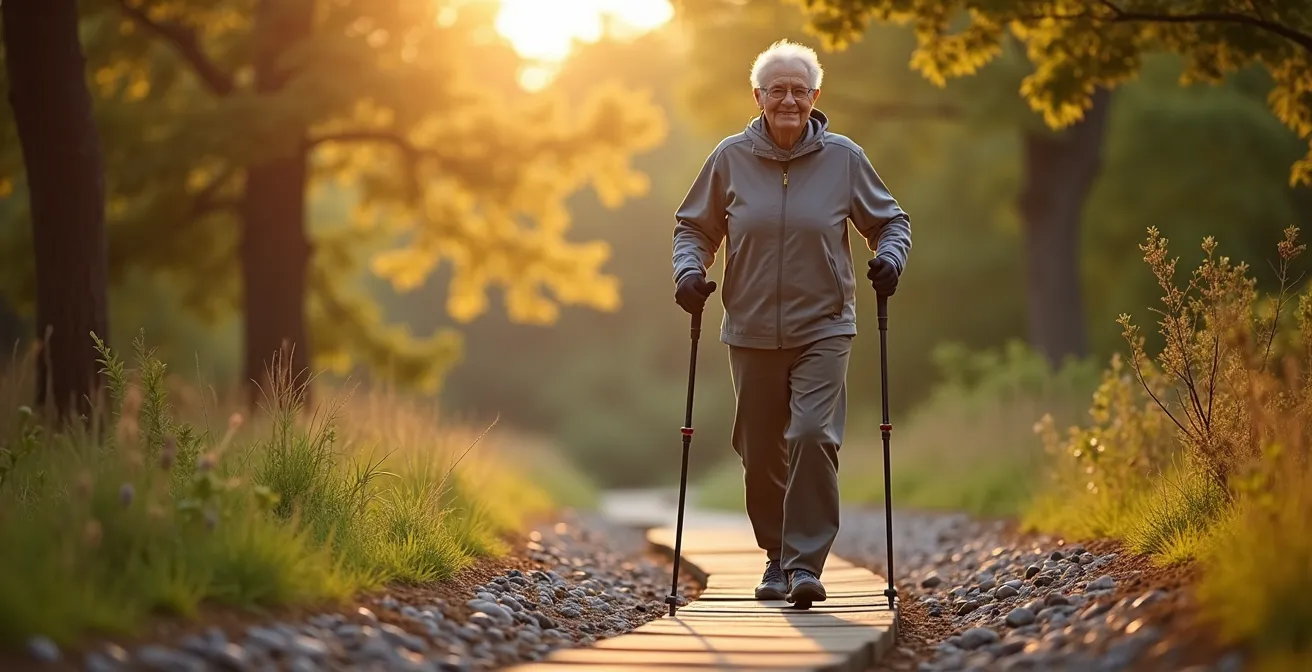
True stability for active seniors isn’t just about stronger muscles; it’s about retraining the brain’s partnership with the inner ear, eyes, and feet.
- Your sense of balance is a dynamic skill, not a fixed attribute, and it can be sharpened with specific exercises that challenge your sensory systems.
- Fear of falling creates a vicious cycle of inactivity that ironically increases your fall risk; breaking this cycle is as crucial as physical training.
Recommendation: Start by mastering the one-leg stand in a safe environment like your kitchen, progressively reducing your hand support to re-educate your body’s natural balance reflexes.
The freedom to walk confidently on a winding park trail, a cobblestone street, or even an uneven lawn is a joy that should be lifelong. Yet for many active seniors, a growing fear of falling can shrink this world, turning a simple walk into a source of anxiety. The conventional advice often revolves around general strengthening exercises or simply being more careful. While well-intentioned, this approach misses the root of the issue.
Many balance problems, especially feelings of dizziness or unsteadiness, aren’t just a matter of muscle weakness. They often originate in a complex and delicate system deep within your inner ear—your vestibular system. Think of it as your body’s internal gyroscope. As we age, its function can decline, sending faulty signals to the brain. But what if the key wasn’t just to build stronger legs, but to recalibrate this internal guidance system?
As a physical therapist specializing in vestibular rehabilitation, I can assure you that you have more control over your balance than you might think. This guide is designed to move beyond generic tips. We will explore the “why” behind age-related dizziness, provide a safe, progressive plan to retrain your balance reflexes, address the psychology of fear, and equip you with the knowledge to choose the right tools—from footwear to walking aids—to navigate any terrain with newfound confidence. This is your roadmap to turning your body back into an intelligent, self-correcting stability machine.
This article will provide a structured approach, from understanding the cause of instability to implementing practical solutions for your home and outdoor activities. The following sections break down each critical component of your journey toward better balance.
Table of Contents: A PT’s Framework for Fall Prevention
- Why Your Inner Ear Function Declines and Causes Dizziness After 60?
- How to Safe-Proof the “One-Leg Stand” Exercise in Your Kitchen?
- The Risk of Limiting Movement Due to Fear of Falling
- Cane vs Trekking Poles: Which Provides Better Stability for Seniors?
- How to Choose House Shoes That Reduce Slip Risks by 50%?
- Why a Hip Fracture Reduces Life Expectancy by 20% in the First Year?
- The Risk of Throw Rugs: The #1 Cause of Living Room Falls
- How to Distinguish Between a Standard Walker and a Rollator?
Why Your Inner Ear Function Declines and Causes Dizziness After 60?
That sudden feeling of spinning or unsteadiness, especially when you turn your head quickly or get out of bed, is not just a vague symptom of aging. It often has a specific physiological cause rooted in your vestibular system. This network of tiny canals and sensors in your inner ear is responsible for detecting head motion and orientation, working in constant communication with your eyes and body to maintain balance. As we age, this system can become less efficient.
One of the most common culprits is Benign Paroxysmal Positional Vertigo (BPPV). This occurs when tiny calcium carbonate crystals, called otoconia, become dislodged and float into the wrong part of the inner ear. This sends confusing signals to your brain, creating a brief but intense sensation of vertigo. The condition is surprisingly common and its prevalence increases dramatically with age. In fact, recent research shows that 4.5% of 75-year-olds have BPPV, a rate almost seven times higher than in young adults.
Beyond BPPV, the general sensitivity of the vestibular nerve endings can decrease, slowing the “righting reflexes” that instantly correct your posture when you stumble. The good news is that, just like a muscle, this system can be retrained. Vestibular rehabilitation therapy (VRT) uses specific exercises to help your brain adapt and compensate for these faulty signals. By performing controlled movements that gently provoke symptoms, you teach your brain to rely more on other sensory inputs (vision and proprioception from your feet) and recalibrate its response, effectively reducing dizziness and improving your functional balance.
How to Safe-Proof the “One-Leg Stand” Exercise in Your Kitchen?
The “one-leg stand” is a classic balance exercise, but for someone with unsteady balance, attempting it without a plan can be intimidating and even risky. The key is not to avoid the challenge, but to create a safe, controlled environment where you can progressively train your stability. Your kitchen counter is the perfect home gym for this purpose. It’s at the right height, it’s sturdy, and it allows for a gradual reduction in support.
The goal is to challenge your sensory integration. When you stand on one leg, your brain must rely more heavily on inputs from your vestibular system and the proprioceptive nerves in your standing foot and ankle. By methodically decreasing your reliance on hand support and, eventually, vision, you force this system to get stronger and more efficient. Think of it as moving from training wheels to riding a bike freely.
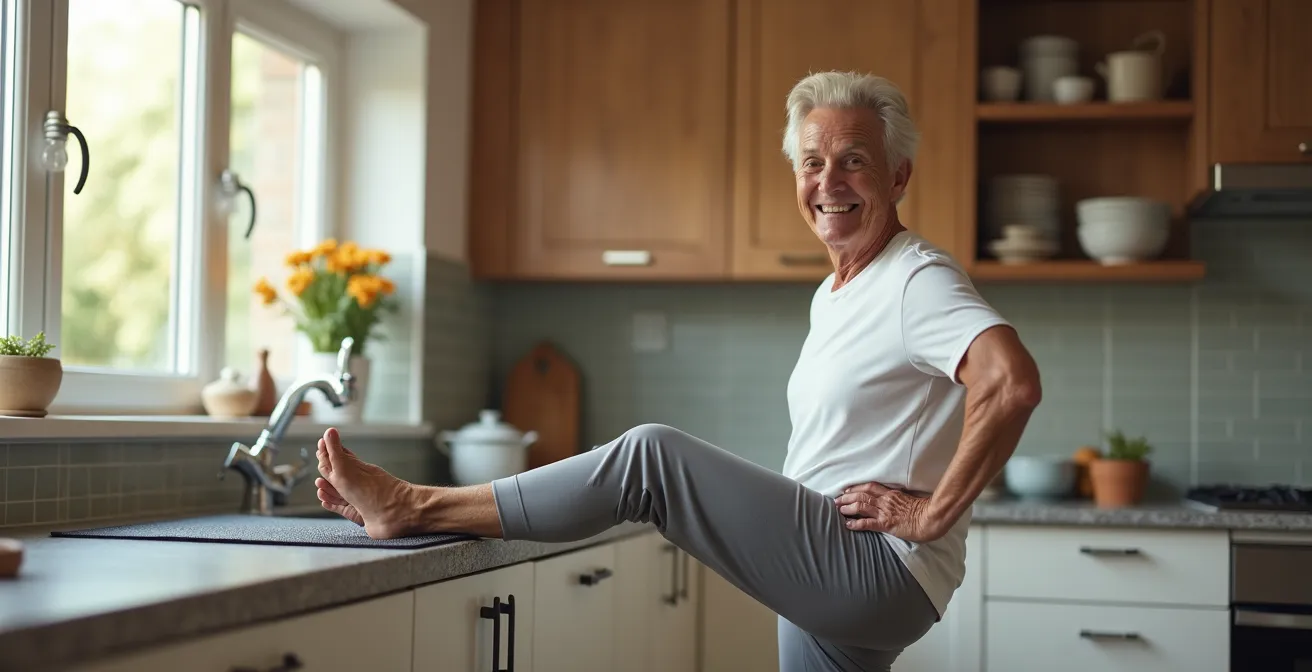
As you can see, proper form is simple but crucial. Stand tall, keep your gaze fixed on a point in front of you, and raise one foot a few inches off the floor. The aim is to hold the position without leaning heavily on the counter. The progression plan below will guide you from full support to advanced challenges, ensuring you build confidence at every stage. Many people ask about the “30-second balance test”; this progression is the safest way to work toward that goal.
Your Action Plan: The Stability Spectrum Progression
- Start with two hands on the counter for full support, focusing on maintaining your posture while on one leg for 10-30 seconds.
- Progress to one hand on the counter, keeping the other at your side. Notice how your standing leg and core have to work harder.
- Lighten your touch to just your fingertips on the counter surface. This provides a safety net while encouraging your body’s reflexes to take over.
- Once stable, try hovering your hand one inch above the surface. Your hand is ready to stabilize you instantly if needed, but your body is now doing all the work.
- Add a cognitive challenge, known as dual-task training: while balancing, count backward from 100 by threes. This simulates real-world situations where you are walking while thinking or talking.
The Risk of Limiting Movement Due to Fear of Falling
The physical decline in balance is only half the story. The psychological impact of a fall—or even just the fear of one—can be just as debilitating. This fear is pervasive; almost 60% of older adults are continuously afraid of falling. This anxiety can trigger a dangerous behavioral pattern that physical therapists call the “fear-avoidance cycle.” It starts with a rational fear, which leads to a conscious decision to move less, avoid uneven surfaces, or decline social outings.
However, this self-imposed limitation has a direct physical consequence. Inactivity leads to muscle atrophy (weakness), decreased joint flexibility, and a dulling of the proprioceptive and vestibular systems that need regular stimulation to stay sharp. This physical deconditioning makes your balance objectively worse, which in turn increases your actual risk of falling. A near-miss or a small stumble then reinforces the initial fear, tightening the loop and leading to even greater inactivity.
Breaking this cycle is a critical part of any fall prevention strategy. It requires a two-pronged approach: rebuilding physical capacity with safe, progressive exercises (like the one-leg stand), and simultaneously rebuilding confidence through “graded exposure.” This means starting with movements you know you can succeed at and gradually expanding your “safe zone.” As clinical experts on the subject explain, the connection is undeniable:
The vicious cycle: fear leads to inactivity, which causes muscle weakness and poor balance, which in turn increases the actual risk of falling and reinforces the fear.
– Clinical experts, Benign paroxysmal positional vertigo in the elderly: current insights
Recognizing this cycle is the first step toward dismantling it. Every successful, confident step you take, no matter how small, is a victory that rewires both your brain and your body for stability.
Cane vs Trekking Poles: Which Provides Better Stability for Seniors?
Choosing the right mobility aid for outdoor walking is a crucial decision that goes beyond simply picking up a cane. For active seniors wanting to tackle parks, trails, or uneven ground, the debate between a single cane and trekking poles (used singly or as a pair) is important. The best choice depends entirely on the terrain, your biomechanical needs, and your stability goals. A cane is excellent for offloading weight from a painful joint on flat surfaces, but its single point of contact offers limited stability on inclines or shifty ground.
Trekking poles, on the other hand, transform the user from a passive recipient of support into an active participant in their stability. Using one or, ideally, two poles engages the upper body and core, widens your base of support to four points, and provides powerful leverage for both ascending and descending hills. They encourage a more upright, dynamic posture compared to the often-stooped posture associated with cane use. This not only improves biomechanical efficiency but also has a positive psychological impact, signaling an active lifestyle rather than frailty.
The following table, based on common physical therapy recommendations, breaks down the ideal use case for each device based on terrain and function. As outlined in a comparative analysis from the National Council on Aging, the context is everything.
| Terrain Type | Cane (Best Use) | Single Trekking Pole | Dual Trekking Poles |
|---|---|---|---|
| Indoor/Flat surfaces | ✓ Excellent – Single-point support | Moderate | Excessive |
| Parks/Light trails | Good | ✓ Excellent | Good |
| Steep inclines | Poor | Good | ✓ Excellent – Maximum stability |
| Biomechanical Function | Passive support/weight offload | Active stability | Full upper body engagement |
| Psychological Impact | May signal frailty | Active lifestyle | Nordic walking association |
Ultimately, the choice is personal. For a walk around the neighborhood, a cane might be sufficient. But for embracing uneven terrain with maximum confidence and a full-body workout, dual trekking poles are often the superior tool for fall prevention.
How to Choose House Shoes That Reduce Slip Risks by 50%?
Your connection to the ground starts with your feet, and the footwear you choose to wear indoors can be either your greatest ally or a significant liability in fall prevention. Many people opt for comfortable, backless slippers or clogs, but these are among the most dangerous choices. Without proper heel containment, your foot can slide, and your toes are forced to “grip” the shoe, altering your natural gait and reducing stability. A secure fastening is the first non-negotiable feature of a safe house shoe.
The second critical element is the sole. It must strike a delicate balance. It needs a good, non-slip rubber tread to provide grip on tile or wood floors, but it should not be overly thick or cushioned. A thick, squishy sole dampens proprioceptive feedback—the vital information your nerves send to your brain about the surface you’re walking on. A thinner, more flexible sole allows your foot to feel the ground, enabling micro-adjustments that are essential for maintaining balance. A simple test for a good shoe is torsional rigidity: if you can twist it like a wet towel, it offers insufficient support.
Finally, don’t underestimate the power of going barefoot. Spending 15-20 minutes each day walking barefoot on safe, clean indoor surfaces is one of the best ways to stimulate the nerves in your feet and sharpen your proprioceptive sense. Consider it a daily “tune-up” for your body’s balance system. A safe house shoe is for walking; barefoot time is for training.
- Secure Fastening: Look for shoes with a closed, contained heel. Avoid all backless styles.
- Adequate Tread: The sole must be made of non-slip rubber with a visible tread pattern.
- Torsional Rigidity: The shoe should feel stable and not twist easily in your hands.
- Proprioceptive Feedback: Choose thinner, flexible soles over overly cushioned ones to better feel the ground.
Why a Hip Fracture Reduces Life Expectancy by 20% in the First Year?
Understanding the gravity of a fall-related injury is a powerful motivator for prevention. A hip fracture is not like a broken arm; it is a life-altering event for an older adult, with consequences that ripple far beyond the initial injury. The statistic that one’s risk of mortality increases significantly in the first year post-fracture is stark but true. This isn’t typically due to the fracture itself, but to the cascade of complications that follows.
The primary driver of this increased mortality is the prolonged period of immobility required for recovery. This inactivity can lead to a host of serious secondary issues: blood clots (deep vein thrombosis or pulmonary embolism), severe muscle wasting (sarcopenia), pressure sores, and infections like pneumonia. The body’s systems, already working with less reserve in older age, can become overwhelmed.
Furthermore, the impact is dramatically worsened by pre-existing health conditions. As detailed in The American Journal of Medicine, comorbidities play a huge role. For instance, an analysis of post-fracture mortality showed that for participants with coronary heart disease, the mortality rate in the first six months was over 2.5 times higher than for those without. A study on the topic found that among participants with heart disease, the mortality rate rose to 79.44 per 100 participant years in the first 6 months post-fracture. The stress of the injury, surgery, and recovery places an immense strain on the cardiovascular system.
This highlights a crucial point: fall prevention is not just about avoiding injury. It is a cornerstone of preserving overall health, independence, and longevity. Every step taken to improve balance is a direct investment in protecting your entire physiological system from a catastrophic cascade effect.
The Risk of Throw Rugs: The #1 Cause of Living Room Falls
While we focus on training the body, we must also address the environment. The single most common culprit for falls inside the home is the seemingly innocent throw rug. According to data on home environment falls, more than 14 million adults 65+ experience a fall each year, and a significant portion of these are tripped by rugs and clutter. The danger lies in the “leading edge curl”—that slight lift of the rug’s edge that is just high enough to catch the toe of a shoe, especially for someone with a shuffling gait.
Busy patterns on rugs can also create a visual-perceptual challenge, camouflaging the edge and making it difficult to discern from the floor. This is particularly dangerous for individuals with declining vision or depth perception. The transition between a hardwood floor and a rug also represents a change in surface texture and height that can easily disrupt balance if not anticipated.
The safest solution from a physical therapy perspective is to remove small throw rugs entirely, especially in high-traffic areas like hallways and living rooms. If you desire the comfort or aesthetic of a rug, the only safe options are large area rugs that are securely anchored on all sides by heavy furniture, or the use of high-quality, double-sided rug tape that fastens the edges firmly to the floor. Low-pile, wall-to-wall carpeting is often the ideal choice, as it provides a consistent, non-slip surface throughout the home.
A simple “home hazard walkthrough” can reveal numerous risks you may have stopped noticing. Look specifically for curled edges, rugs that slide easily, and poor lighting in transition zones between rooms. Eliminating these environmental hazards is as crucial as any balance exercise.
Key Takeaways
- True balance comes from retraining the sensory partnership between your inner ear, eyes, and feet—a skill you can actively improve.
- The fear of falling leads to a cycle of inactivity that worsens balance; breaking this cycle with confident, gradual movement is crucial.
- Your environment matters: choosing secure, thin-soled footwear and eliminating hazardous throw rugs are simple changes with a massive impact on safety.
How to Distinguish Between a Standard Walker and a Rollator?
When more significant support is needed, many people use the terms “walker” and “rollator” interchangeably, but they are fundamentally different tools with distinct use cases. Choosing the wrong one can increase fall risk. The critical distinction lies in their primary function: a standard walker is built for stability and weight-bearing, while a rollator (a walker with wheels) is designed for gait support and endurance.
A standard walker has no wheels (or only on the front legs) and requires a “lift-place-step-repeat” gait pattern. This is a deliberate, slow, and highly stable process. It’s the correct choice for individuals who need to bear significant weight through their arms due to weakness, pain, or poor balance. The simple motor plan also places a low cognitive load on the user. In contrast, a rollator has three or four wheels and moves continuously. It requires the user to actively steer, brake, and walk simultaneously. This increased cognitive load can be difficult for some, and there is a “runaway risk” if the user pushes it too far ahead and tries to catch up, leading to a fall.
The diagnostic question a physical therapist often asks is: “Do you need to bear significant weight through your arms when you walk?” If the answer is yes, a standard walker’s fixed stability is necessary. If the answer is no, and the primary need is for light balance support and a place to rest (the seat), then a rollator can be an excellent tool for maintaining community ambulation and independence. This data from NCOA’s fall prevention resources helps clarify the decision.
| Factor | Standard Walker | Rollator |
|---|---|---|
| Weight Bearing Need | High – Full arm support available | Low – Primarily for balance |
| Gait Pattern | Lift-Place-Step-Repeat (deliberate) | Continuous rolling (requires control) |
| Cognitive Load | Simple, repetitive motor plan | Complex: steering + braking + walking |
| Fall Risk | Forces safer, slower pace | ‘Runaway risk’ if pushed too far ahead |
| Best For | Significant weakness, cognitive decline | Good strength, needs rest spots |
By understanding the physiology of balance, committing to a safe training plan, and making informed choices about your environment and assistive tools, you can profoundly reduce your risk of falling. The next logical step is to integrate this knowledge into a consistent daily routine. Start today by assessing your home for hazards and scheduling just five minutes for your first kitchen counter balance session.