
The right mobility aid isn’t about adding support; it’s about strategically managing energy to expand one’s world.
- Standard walkers offer maximum stability for those with significant balance issues, but require lifting, which consumes energy.
- Rollators use wheels and a seat to conserve energy, enabling users to travel farther by turning walking into a “walk-and-rest” activity.
Recommendation: Evaluate the user’s daily environment and energy levels first. Choose the device that best supports their lifestyle goals, not just their immediate need for balance.
For families navigating the world of durable medical equipment, the aisle of walking aids can be bewildering. Side-by-side, the standard walker and the rollator look similar yet serve fundamentally different purposes. The common advice is simple: walkers are for stability, and rollators are for those who are a bit more active. While true, this advice misses the most critical factor in the decision: energy management. Choosing the right device isn’t just about preventing a fall; it’s about conserving a finite amount of personal energy to live a fuller, more independent life.
The decision transcends a simple feature comparison of “wheels vs. no wheels.” It’s about understanding the biomechanics of walking with support. A standard walker demands a “lift-and-place” motion that, while providing a stable base, constantly expends energy. A rollator, on the other hand, is designed around the principle of energy economy, using wheels to eliminate lifting and a built-in seat to provide strategic rest. This guide moves beyond the surface-level differences to decode the ‘why’ behind each design feature. We will explore how brakes, wheel size, and weight are not just specifications, but tools that directly impact a person’s functional threshold and ability to engage with their world.
This article will guide you through the key functional differences between these two essential mobility aids. By understanding the core principles of stability, energy conservation, and environmental friction, you can make an informed choice that empowers your loved one, extending their range and confidence.
Summary: Understanding the Core Differences Between Walkers and Rollators
- Why Loop Brakes Are Easier for Weak Hands Than Push Brakes?
- The “Sit and Rest” Strategy: How a Rollator Extends Walking Range?
- The Risk of Small Wheels: Why You Get Stuck on Carpet?
- Lightweight vs Heavy Duty: Lifting Your Rollator into a Car Trunk
- Trays and Baskets: How to Carry Dinner Safely with a Walker?
- The Risk of Ignoring Chronic Fatigue as a Normal Part of Aging
- Cane vs Trekking Poles: Which Provides Better Stability for Seniors?
- How to Navigate the Psychological Shift to a Power Wheelchair?
Why Loop Brakes Are Easier for Weak Hands Than Push Brakes?
One of the most significant, yet often overlooked, advantages of a rollator is its braking system. Unlike the friction-based glides on a standard walker, rollators feature active brakes, most commonly loop-style brakes similar to those on a bicycle. This design is not accidental; it’s a direct solution for users with compromised grip strength, such as those with arthritis. A standard push-down brake on some walkers requires significant downward force concentrated on the palm, which can be painful and difficult to sustain. In contrast, loop brakes utilize a whole-hand grip.
This ergonomic design distributes the required pressure across all fingers and the palm, reducing strain on any single joint. The motion is a gentle squeeze rather than a forceful push, making it more intuitive and less demanding. For a person with weak or painful hands, this difference is critical for safety and confidence. The ability to control speed and stop securely without causing pain is a cornerstone of safe mobility. Furthermore, most loop brakes include a parking brake function. By pushing the lever down until it clicks, the user can lock the wheels completely, ensuring the rollator remains stationary when they are sitting down or standing up from the seat. This feature provides a stable base without requiring continuous hand pressure.
To fully appreciate the mechanical advantage, it’s helpful to see the grip in action. The hand naturally conforms to the lever, allowing for confident control with minimal effort.
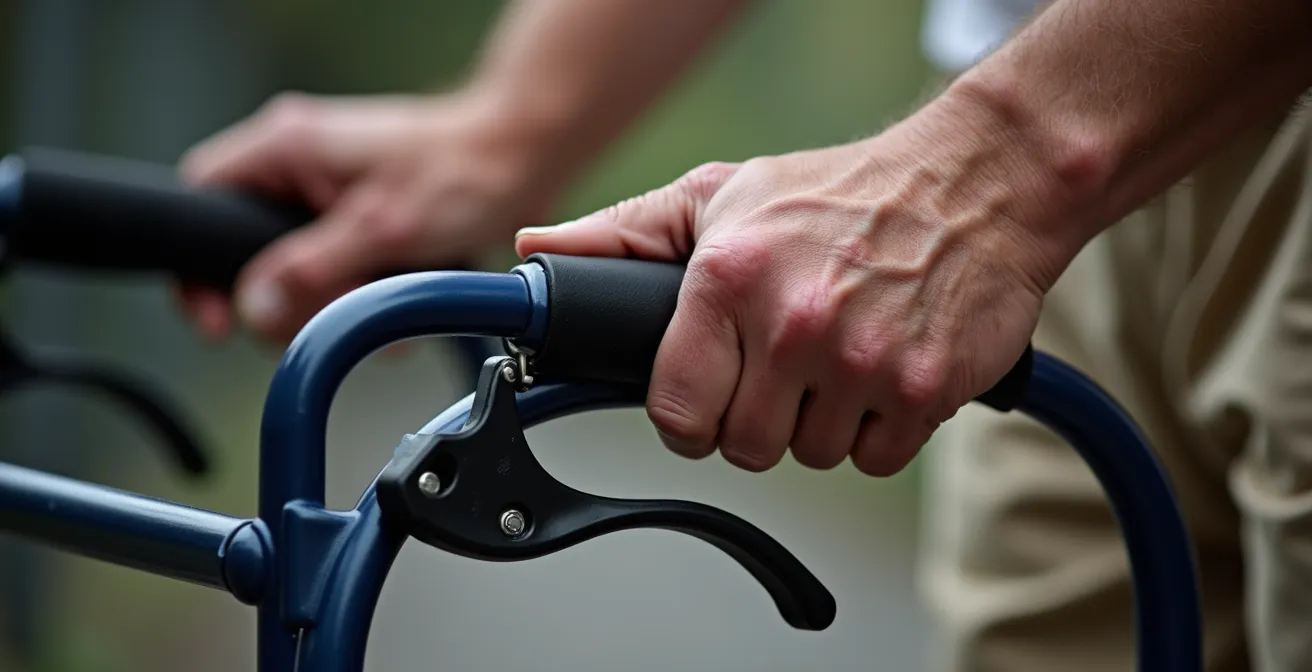
As this demonstrates, the design allows for nuanced control over the rollator’s movement. A user can gently squeeze to slow their pace on a decline or pull firmly for an immediate stop. This level of control is essential for navigating varied environments safely and maintaining proper gait dynamics. The brake cable tension can also be adjusted by a professional to perfectly match the user’s specific grip strength, personalizing the device for optimal safety.
The “Sit and Rest” Strategy: How a Rollator Extends Walking Range?
The most defining feature of a rollator is its integrated seat. This is not merely a convenience; it is the core component of a powerful energy economy strategy. For individuals whose mobility is limited by fatigue, shortness of breath, or chronic pain, the ability to walk is dictated by their functional threshold—the point at which they must stop and rest. A standard walker offers no solution for this; the user must find an external bench or chair, which may not be available. This severely limits the potential walking distance and can create anxiety about venturing too far from a known resting place.
A rollator fundamentally changes this dynamic by making rest an integral part of the journey. The “sit and rest” strategy allows a user to walk until they begin to feel tired, then immediately sit, recover their energy, and continue. This cycle of walking and resting can dramatically extend the total distance a person can cover. It transforms a trip to the mailbox into a walk around the block, or a short stroll in the mall into a longer shopping excursion. According to mobility experts, rollators are especially helpful for people who want the ability to walk longer distances with the reassurance of having a place to rest when needed. This feature is crucial for maintaining cardiovascular health and muscle tone, as it encourages longer periods of activity.
The strategic advantage of a rollator’s design becomes clear when comparing its features directly against a standard walker, as a detailed comparison of energy management features reveals.
| Feature | Standard Walker | Rollator with Seat |
|---|---|---|
| Rest Capability | Must find external seating | Fixed or fold-up seat on which a person can sit |
| Energy Conservation | Continuous standing required | Periodic rest breaks possible |
| Walking Range | Limited by fatigue | Perfect for use over long distances |
| Terrain Adaptability | Indoor/smooth surfaces | More ‘all-terrain’ than traditional walkers |
By providing an on-demand resting spot, the rollator empowers users to push their boundaries safely. This builds not only physical stamina but also psychological confidence, reducing the fear of being stranded by fatigue and encouraging greater participation in daily life.
The Risk of Small Wheels: Why You Get Stuck on Carpet?
While a rollator’s wheels provide freedom, their size is a critical factor that directly impacts safety and usability. A common complaint from new users is that their rollator gets “stuck” on plush carpets, doorway thresholds, or cracks in the sidewalk. This phenomenon is a matter of simple physics, or what can be called environmental friction. Smaller wheels, typically 6 inches or less, have a more difficult time overcoming obstacles. When they encounter an obstacle like the edge of a thick rug, their forward momentum is more easily converted into an upward force that stops the wheel in its tracks, creating a tripping hazard.
Larger wheels, on the other hand, have a greater circumference and a better angle of attack. They can roll over small obstacles more easily, providing a smoother and safer ride. This is why a key consideration when selecting a rollator is its intended environment. For primarily indoor use on smooth, level floors, 6-inch wheels may suffice. However, for navigating a home with varied flooring or for venturing outdoors, experts recommend larger 8-inch wheels for better stability. These larger wheels not only handle obstacles better but also absorb more vibration from uneven surfaces, reducing fatigue in the user’s hands and arms.
Choosing the right wheel is not just about a smooth ride; it’s about matching the tool to the terrain to prevent sudden stops and potential falls. For anyone planning to use their rollator both indoors and outdoors, investing in a model with larger wheels is a crucial safety decision.
Checklist: Selecting the Right Wheel Size
- Assess your environment: Determine if the rollator will be used primarily indoors on smooth floors or on more varied terrain like carpets, sidewalks, and gardens.
- Evaluate terrain complexity: For uneven grounds, choose larger wheels (8-10 inches) as they have fewer revolutions and absorb more shock, reducing vibration.
- Consider user stature: Smaller 6-inch wheels can be suitable for more petite users who will only use the device indoors.
- Check wheel material: Prioritize high-quality rubber wheels, which offer superior durability, a softer ride, and better grip compared to plastic.
- Plan for the future: If outdoor activities are a goal, select a model with larger wheels from the start to ensure the rollator can adapt to new challenges.
Lightweight vs Heavy Duty: Lifting Your Rollator into a Car Trunk
A rollator’s utility is only as good as its portability. For many users and their families, a key daily task is lifting the device into and out of a car trunk. This is where the trade-off between frame weight and user weight capacity becomes a critical decision point. Rollators come in several weight classes, from ultra-lightweight carbon fiber models to heavy-duty steel frames designed for bariatric users. The material and construction directly influence not only the rollator’s own weight but also its durability and how much weight it can safely support.
For users who frequently travel by car, a lightweight rollator is often the best choice. These models, typically made of aluminum or carbon fiber, weigh between 11 and 14 pounds. This lighter weight makes them significantly easier for a senior or a caregiver with limited strength to lift and maneuver. A standard aluminum rollator weighs a bit more, around 15 to 18 pounds, offering a balance of portability and sturdiness. In contrast, heavy-duty rollators are built with reinforced steel to support user weights between 400 and 500 pounds, but the device itself can weigh 20 to 30 pounds, making it challenging to lift.
A look at a comparison of rollator weight categories shows the clear trade-offs between materials and purpose.
| Type | Weight Range | Material | Best For |
|---|---|---|---|
| Lightweight | 11-14 pounds | Aluminum/Carbon Fiber | Frequent car loading |
| Standard | 15-18 pounds | Aluminum | General use |
| Heavy-Duty | 20-30 pounds | Reinforced Steel | Weight capacity for most heavy-duty rollators is between 400 lb and 500 lb |
Beyond just the weight, the folding mechanism is crucial for portability. A good rollator should fold compactly and have a locking mechanism to keep it closed during transport. When lifting, it’s essential to use proper body mechanics: bend at the knees, keep the back straight, and hold the rollator close to the body. A “slide and pivot” technique can also make loading easier.

Ultimately, the choice depends on balancing the user’s weight requirements with the physical ability of the person who will be handling the device most often. For many, a slightly more expensive but lighter model is a worthwhile investment in convenience and safety.
Trays and Baskets: How to Carry Dinner Safely with a Walker?
A simple daily task like carrying a plate of food or a cup of coffee from the kitchen to the living room can become a major challenge for someone using a walking aid. Both hands are needed to operate the device, leaving no way to safely transport items. This is where accessories like trays and baskets become essential tools for maintaining independence, not just convenient add-ons. However, the best solution differs significantly between a standard walker and a rollator due to their fundamental design differences.
For a standard walker, a walker tray is the ideal solution. These plastic trays are designed to fit securely over the top of the walker frame, creating a stable, level surface. By placing items on the tray, the user can push the walker ahead of them, step forward, and repeat, keeping their hands free to grip the walker for support. It is crucial to choose a properly designed tray and to place heavier items in the center to maintain the walker’s center of gravity and prevent it from tipping. Improvised solutions, like trying to hang a bag from the frame, can be extremely dangerous as they can alter the walker’s balance.
For rollators, the solution is typically an under-seat basket or pouch. Many models come with these convenient storage options built-in. Placing items in a basket positioned low and in the center of the frame is the safest method, as it has a minimal effect on the rollator’s stability and gait dynamics. While some rollators can accommodate a tray over the seat, this is generally less stable than using a walker tray, as the rollator can still roll. The under-seat basket provides a secure and out-of-the-way storage space, perfect for personal belongings, shopping, or even a small meal on a covered plate.
The Risk of Ignoring Chronic Fatigue as a Normal Part of Aging
One of the most dangerous misconceptions about aging is that chronic fatigue is an unavoidable and “normal” consequence. While energy levels may naturally decline, persistent, debilitating fatigue is often a symptom of an underlying issue or, more commonly, the result of a vicious cycle of inactivity. When a person fears falling or feels unsteady, they tend to move less. This reduction in activity leads to muscle atrophy and deconditioning, which in turn makes any physical effort more tiring. This fatigue then further discourages activity, creating a downward spiral that severely impacts quality of life.
Introducing a properly selected mobility aid—be it a walker or a rollator—is a powerful intervention to break this cycle. The primary goal of an assistive device is not just to prevent falls, but to provide the necessary support and confidence for an individual to remain active. By feeling more secure, a person is more likely to walk, whether it’s around the house or in the community. This sustained activity helps maintain muscle mass, improves cardiovascular health, and ultimately combats the feeling of chronic fatigue. The aid becomes a tool that raises their functional threshold, allowing them to do more before fatigue sets in.
Breaking the Fatigue-Inactivity Cycle with a Mobility Aid
Research consistently shows that the goal of an assistive device is to support an individual so they can walk safely and for greater distances, which is a key factor in fall prevention. As one study on breaking the fatigue-inactivity cycle demonstrates, the successful introduction of a walker or rollator helps seniors maintain crucial activity levels. This intervention actively prevents the muscle atrophy and deconditioning that directly cause and worsen chronic fatigue, turning the mobility aid into a tool for proactive health maintenance.
Ignoring chronic fatigue as “just part of getting older” means overlooking an opportunity to improve health and independence. By providing the right support, families can help their loved ones stay active, engaged, and energized. The choice between a walker for stability or a rollator for energy conservation should be guided by which tool will best empower the user to move more and live more.
Cane vs Trekking Poles: Which Provides Better Stability for Seniors?
Before a walker or rollator is needed, many seniors rely on a single cane for mild balance support. A cane is excellent for helping with a limp or providing a third point of contact with the ground. However, its support is inherently one-sided and asymmetrical. For more active seniors looking for a way to improve stability while also getting a fitness benefit, dual trekking poles have emerged as a superior alternative. Unlike a cane, which is a passive support tool, trekking poles encourage active, symmetrical engagement.
Using two trekking poles promotes an upright posture and a more natural, balanced gait dynamic. The “opposite arm, opposite leg” rhythm engages the entire upper body—shoulders, back, and core—turning a simple walk into a full-body workout. This increased muscle engagement burns more calories and improves overall strength and conditioning. For seniors with mild to moderate balance issues but who are otherwise active, trekking poles offer a more dynamic and stabilizing form of support than a single cane, which can sometimes create an uneven gait pattern over time.
The choice between these two aids depends entirely on the user’s goals and physical condition. A cane is for simple, one-sided support, while trekking poles are for active stability and fitness.
| Feature | Single Cane | Dual Trekking Poles |
|---|---|---|
| Support Type | Provides mild balance support | Active bilateral support |
| Gait Pattern | Asymmetrical, one-sided | Symmetrical, balanced |
| Upper Body Engagement | Minimal | Full upper body workout |
| Best For | Helps with a limp but isn’t ideal for those with severe balance issues | Active seniors wanting fitness benefits |
For those considering a transition from a cane to trekking poles, it’s important to start slowly. Learning the coordinated movement takes practice, but the benefits in terms of improved stability, posture, and overall fitness can be substantial for the right individual.
Key Takeaways
- A rollator’s primary advantage is energy conservation through its wheels and seat, extending walking distance.
- A standard walker provides maximum stability by creating a fixed base of support, ideal for significant balance issues.
- Wheel size is critical: larger wheels (8″+) are safer for varied terrain, while smaller wheels are for indoor use only.
How to Navigate the Psychological Shift to a Power Wheelchair?
For some, the progression of mobility needs doesn’t stop with a walker or rollator. The transition to a power wheelchair can be a psychologically challenging step, often perceived as a significant loss of independence. However, it is crucial to reframe this narrative. The ultimate goal of any mobility device is to enable freedom and participation in life. If chronic fatigue, pain, or instability have become so severe that even a rollator is no longer sufficient to leave the house, then a power wheelchair is not an admission of defeat; it is the key to regaining one’s world.
This shift is about mobility as empowerment. Viewing these aids as tools for independence rather than symbols of limitation is transformative. Studies show that when users embrace power wheelchairs, they report expanded social participation and a renewed engagement in activities they had previously abandoned. The chair becomes the vehicle that allows them to visit grandchildren, go to the grocery store, or attend community events. It restores a level of freedom and spontaneity that was lost. As one expert, Dr. Archie, advises, “It’s not just about the most popular model; it’s about what’ll best support the individual’s daily life and mobility goals.”
The conversation should focus on what can be gained, not what is being lost. Discussing the new possibilities—longer outings, less pain, and reduced reliance on others—can help ease the transition. It’s about choosing the right tool for the job. When walking is no longer a viable way to engage with the world, a power wheelchair can be the most empowering tool of all, allowing users to reclaim their mobility and independence on their own terms, as it provides them with safe tools for independence rather than symbols of limitation.
Ultimately, choosing the right mobility aid is a deeply personal decision that should be centered on enhancing quality of life. To ensure you are selecting the most appropriate device, the next step is to conduct a thorough assessment of the user’s daily activities, home environment, and long-term mobility goals with a healthcare professional or a qualified DME provider.