
Chronic loneliness is not an emotional problem; it’s a diagnosable medical condition with severe physical consequences that you can learn to spot.
- The stress of isolation acts like a poison, physically shrinking the brain and accelerating cellular aging.
- Observable signs are not just sadness, but neglect of personal care, an unkempt home, and physical symptoms like headaches or digestive issues.
Recommendation: Shift your mindset from treating their sadness to identifying their symptoms. Your vigilance can be the frontline defense against a silent but deadly illness.
Watching an aging parent withdraw from the world is a uniquely painful experience. You see them turning down invitations, letting calls go to voicemail, and retreating into a shell. The common advice is to encourage more social activities, to “get them out of the house.” We treat their loneliness as a problem of mood or morale, something that can be fixed with a bit of cheerfulness and a few more phone calls.
But this approach fundamentally misunderstands the crisis at hand. What if the lethargy, the forgetfulness, and the sudden physical complaints aren’t just signs of old age or sadness? What if they are the clinical symptoms of a severe underlying condition? The devastating truth is that chronic isolation is not a feeling; it is a pathology. It inflicts measurable, physical damage on the human body, with consequences as dire as those of heavy smoking.
This guide reframes the issue entirely. We will not be discussing how to cheer up your loved one. Instead, we will equip you with the knowledge of a public health professional. You will learn to identify the silent physical footprints of loneliness—from its impact on the brain’s structure to the subtle clues in their daily environment. Understanding these signs is the first, critical step in intervening before independence becomes a danger, and before isolation claims a toll from which there is no return.
This article provides a clinical overview of loneliness as a health risk, offering practical diagnostic tools and protective strategies. By exploring the mechanisms of this condition, you can shift from a concerned child to an informed advocate for your parent’s health.
Summary: The Clinical Guide to Understanding the Pathology of Loneliness
- Why Loneliness Is Equated to Smoking 15 Cigarettes a Day?
- How to Maintain Family Bonds When Living 500 Miles Apart?
- The Risk of Digital Exclusion: When Tech Illiteracy Leads to Isolation
- How to Re-engage with Life After the Loss of a Long-Term Spouse?
- Dogs vs Cats: Which Pet Best Reduces Feelings of Loneliness?
- The Risk of Loneliness: How It Shrinks the Hippocampus
- The 3 Silent Signs That Independence Is Becoming Dangerous for Seniors
- How to Build a “Social Portfolio” That Protects Against Cellular Aging?
Why Loneliness Is Equated to Smoking 15 Cigarettes a Day?
The comparison of loneliness to smoking 15 cigarettes a day isn’t a metaphor; it’s a stark, data-driven medical warning. The risk it poses is not just emotional but profoundly biological, leading to a quantifiable reduction in lifespan. The Surgeon General’s 2023 report highlighted that social disconnection is associated with a 26% increased risk of premature death. This isn’t about feeling sad; it’s about a physiological state of emergency that wears the body down from the inside out, triggering chronic inflammation, elevated blood pressure, and a weakened immune system.
The mechanism behind this destructive power is a chronic stress response. When a person feels isolated, their body perceives a constant, low-level threat. This triggers a cascade of hormonal and neurological changes that are helpful in short bursts but toxic over the long term. This is the physiological footprint of loneliness: a body perpetually braced for a danger that never comes, and never leaves.
Loneliness functions as a chronic social stressor that activates the hypothalamic–pituitary–adrenal (HPA) axis and sympathetic nervous system, leading to increased cortisol and catecholamines.
– Beese et al., Stress Journal
This constant flood of stress hormones like cortisol is corrosive. It disrupts sleep, impairs digestion, and directly contributes to the cellular damage that accelerates aging. In essence, the body of a chronically lonely person is in a continuous state of high alert, diverting resources from essential functions like immune defense and cellular repair. Over time, this state of physiological siege leads to the same spectrum of chronic diseases associated with other major health risks, including heart disease, stroke, and dementia.
How to Maintain Family Bonds When Living 500 Miles Apart?
For adult children living hundreds of miles away, the guilt and helplessness can be overwhelming. You cannot simply “drop by” to check in. However, distance does not have to be a death sentence for connection. The key is not sporadic, lengthy calls but creating a predictable, woven tapestry of communication. It’s about establishing consistent communication routines that become an expected and comforting part of daily or weekly life. This consistency is what combats the feeling of abandonment and unpredictability that fuels isolation.
Technology, when used intentionally, is the most powerful tool in your arsenal. Video chatting applications like Zoom and FaceTime are non-negotiable; seeing a face provides a layer of emotional data and connection that a voice-only call can never replicate. But it goes beyond simple calls. It’s about creating shared digital experiences. You can take a virtual tour of a museum together, watch a favorite classic movie simultaneously, or join an online class or faith-based service from your respective homes. This shifts the interaction from a “check-in” to a shared, meaningful activity.
Case Study: The Talking Tech Pilot Program
A pilot program provided tablets and training to homebound older adults to combat isolation. The results were profound. Participants used the devices not just for calls, but to explore the world through virtual museum tours, access educational content, and reconnect with family. The program’s success demonstrates that with the right tools and support, technology can be a powerful lifeline. As one participant stated, the program “knocked me right out of my loneliness” by fostering new and meaningful digital connections.
The goal is to build a multi-channel web of connection. A scheduled weekly video call, supplemented by daily quick texts with a family photo, a short email with an interesting article, or even a physical letter in the mail, creates a sense of constant, low-stakes presence. This rhythm of connection provides the security and reassurance that even though you are 500 miles away, they are not, and will never be, alone.
The Risk of Digital Exclusion: When Tech Illiteracy Leads to Isolation
In a world where social life has migrated online, the inability to navigate the digital landscape is no longer a minor inconvenience; it’s a primary driver of social isolation. For many seniors, the very tools designed to connect us—social media, video calls, messaging apps—are insurmountable barriers. This isn’t about a lack of willingness, but often a lack of familiarity, comfort, or the cognitive and physical dexterity to manage complex interfaces. When family updates happen in a group chat and event invitations are sent via email, the person who can’t log in is effectively rendered invisible. Research indicates that this is a widespread crisis, with studies showing 1 in 10 older people always or often feel lonely, a figure exacerbated by the digital divide.
The problem is compounded by a fear of being a burden. Many seniors are hesitant to ask for help repeatedly, worried about seeming incompetent or frustrating their more tech-savvy family members. This leads to a quiet retreat, where the senior simply disengages from the digital world, and by extension, from the social circles that now inhabit it. The result is a profound and deepening isolation, hidden in plain sight.
Overcoming this requires patience, empathy, and tailored solutions. It’s not about buying them the latest device; it’s about finding the right device and providing one-on-one, repeatable training. It means writing down step-by-step instructions in a large-print notebook, setting up simplified interfaces, and celebrating small victories. The goal isn’t to turn them into a tech wizard, but to give them mastery over the one or two applications that matter most for family connection.

As the image above suggests, the process can be one of determination and rediscovery. Each successful video call or shared photo is a powerful affirmation of their capability and a direct blow to the loneliness that threatens to engulf them. Breaking down the wall of digital exclusion is one of the most critical interventions a family can make, reopening a window to the world that was closing day by day.
How to Re-engage with Life After the Loss of a Long-Term Spouse?
The death of a long-term spouse is more than the loss of a person; it’s the amputation of a part of one’s identity. The surviving partner loses their primary companion, their confidant, and the keeper of their shared history. This profound void is a significant catalyst for deep, pathological loneliness. Re-engagement is not about “moving on” or “replacing” the lost partner, but about the painstaking process of rebuilding a new life structure and sense of purpose. This process must begin with acknowledging and processing the grief itself.
Participating in grief support groups, often available through hospice organizations or local community centers, is a critical first step. These groups provide a safe space where individuals can share their experiences with others who truly understand the depth of their loss. It normalizes the overwhelming emotions and provides a community of peers, which is the first building block in constructing a new social world. From there, the focus can shift from mourning the past to cautiously building a new future.
This involves re-engaging with the community, but in a way that feels authentic and purposeful. This could mean returning to a long-abandoned hobby, joining a book club, or taking an educational class at a local college. For many, engaging in volunteer work is particularly powerful. It provides a structured routine, a new set of colleagues, and, most importantly, a renewed sense of purpose and usefulness. It shifts the individual’s role from a passive recipient of care to an active contributor to their community. Befriending services that connect seniors with trained volunteers can also be an invaluable bridge back into social life, offering one-on-one companionship without pressure.
Ultimately, the goal is to help them develop a diversified “portfolio” of social connections. This portfolio includes different types of relationships—from close family to casual acquaintances from a hobby group—that provide various forms of support and interaction. This diversification makes them more resilient to future losses and provides a rich, multi-layered social life that can bring meaning and joy back into their days.
Dogs vs Cats: Which Pet Best Reduces Feelings of Loneliness?
Introducing a pet into a lonely senior’s life can be one of the most effective, non-pharmacological interventions available. The unconditional love and constant presence of an animal can profoundly improve both mental and physical health. A National Poll on Healthy Aging found that pet companionship improves both physical and mental health in older adults. However, the choice between a dog and a cat is not a simple matter of preference; it’s a clinical decision that should be based on the senior’s physical capabilities, living situation, and emotional needs.
The primary therapeutic mechanism of a dog is behavioral activation. Dogs have non-negotiable needs: they must be walked, fed, and let outside on a strict schedule. This forces the owner into a routine of physical activity and engagement with the outside world. Daily walks not only provide exercise but also create opportunities for social interaction with other dog owners. For a senior struggling with depression-induced inertia, the demands of a dog can be the very thing that pulls them out of bed and back into life. Conversely, cats operate on a principle of sensory soothing. They require far less physical maintenance and are content to live indoors. Their value lies in their quiet, comforting presence. The act of stroking a cat’s fur and listening to its purr has been shown to lower blood pressure and reduce anxiety. For a senior with limited mobility or one who finds the demands of a dog overwhelming, a cat offers companionship without the physical obligations.
The following table breaks down the key differences to help guide this important decision, as analyzed by senior care experts.
| Aspect | Dogs | Cats |
|---|---|---|
| Physical Activity | Enforced daily walks provide behavioral activation | Low physical demands, suitable for limited mobility |
| Social Interaction | Creates opportunities to meet other dog owners | Provides companionship without social obligations |
| Routine Structure | Non-negotiable feeding and walking schedules | Flexible care requirements |
| Therapeutic Mechanism | Behavioral activation for depression | Sensory soothing through anxiety |
| Care Demands | High maintenance, requires outdoor access | Lower maintenance, indoor-suitable |
Ultimately, there is no single “best” pet. The right choice depends on a careful assessment of the senior’s needs and limitations. A dog can be a powerful motivator for an able-bodied but depressed senior, while a cat can be a calming and manageable companion for someone who is frail or less mobile.
The Risk of Loneliness: How It Shrinks the Hippocampus
The most alarming physical consequence of chronic loneliness is not visible to the naked eye. It occurs deep within the brain, in a region critical for memory and learning: the hippocampus. Mounting neuroscience research reveals a terrifying link: chronic social isolation can lead to physical atrophy, or shrinking, of the hippocampus. This structural brain damage is not a future risk; it is an ongoing process in the chronically lonely. The impact is devastating, as analysis of this research reveals a 20% increased risk of developing dementia for those who feel lonely.
The mechanism is rooted in the chronic stress response we’ve discussed. The constant production of stress hormones like cortisol is neurotoxic. As explained by the Center for Healthy Aging at Penn State, these glucocorticoids are particularly poisonous to the delicate neurons in the hippocampus. They inhibit the birth of new neurons (neurogenesis) and accelerate the death of existing ones, leading to a measurable loss of brain volume. This is the biological scar of loneliness—a brain physically weakened and less resilient, making it more vulnerable to the ravages of age-related cognitive decline.
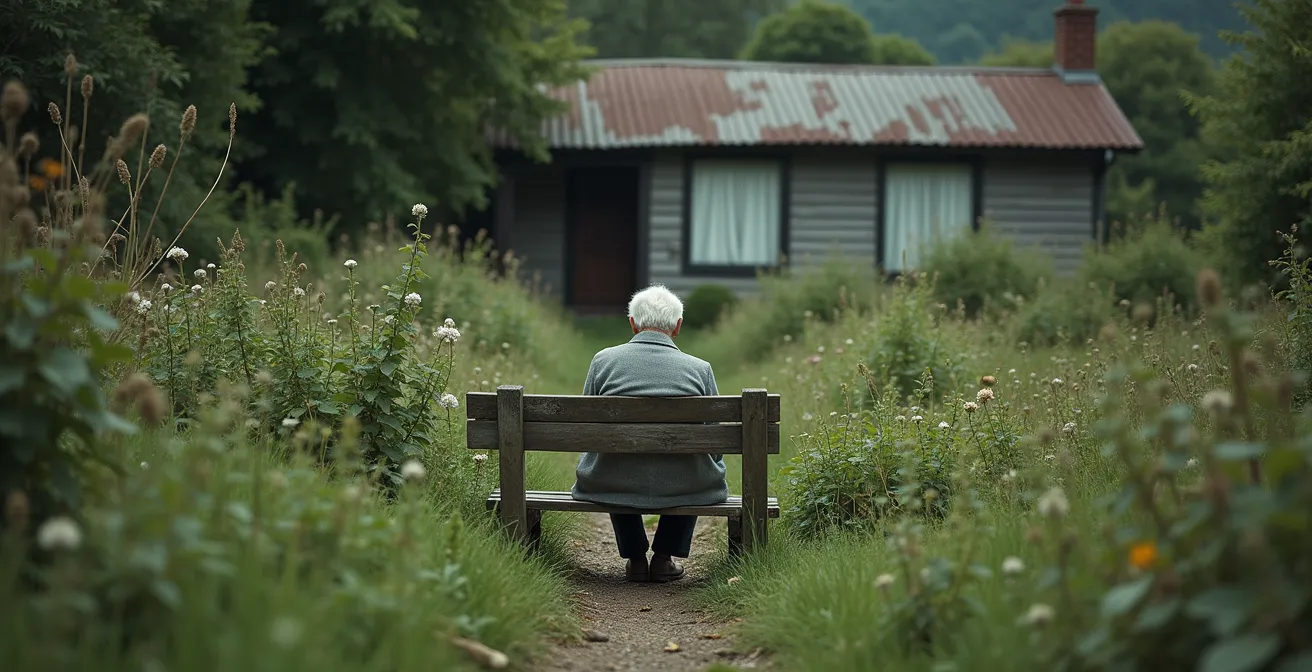
This internal decay is often mirrored by a decline in the person’s external environment, a concept we can call environmental neglect. As shown in the image, an unkempt garden, a cluttered house, or unopened mail are not signs of laziness. They are the physical manifestations of a shrinking world and a brain struggling to cope. When the hippocampus is under siege, executive functions like planning, motivation, and organization falter. The ability to manage one’s own environment—a key indicator of independence—is one of the first casualties. The overgrown garden is a direct reflection of an atrophying hippocampus.
This connection is critical for family members to understand. The forgetfulness, the confusion, and the messy house are not character flaws. They are the clinical symptoms of a brain under attack. Recognizing this link is essential for providing compassionate, effective support and for intervening before the cognitive decline becomes irreversible.
The 3 Silent Signs That Independence Is Becoming Dangerous for Seniors
As a public health nurse, I must be direct: the line between cherished independence and genuine danger is often invisible to the senior themselves. It falls to you, the vigilant loved one, to act as a compassionate diagnostician. The most critical symptoms of pathological loneliness are not tearful confessions; they are silent, physical signs that their capacity to care for themselves is failing. These are the red flags that require immediate and serious attention.
The first and most obvious sign is a decline in personal care and grooming. Is your parent, who was once meticulous, now wearing stained clothing? Have they lost a significant amount of weight, or are they forgetting to take their medications? These are not small oversights. They are indicators of depression, cognitive decline, or a simple lack of energy—all rooted in the crushing weight of isolation. This is often paired with a withdrawal from previously enjoyed activities, a clear sign that the motivation to engage with life is waning.
The second sign is a loss of what we call environmental mastery. Pay close attention to the state of their home the next time you visit. Is the house unusually cluttered or dirty? Is the garden overgrown, the mailbox overflowing? These are not signs of laziness; they are symptoms of executive dysfunction. The motivation and cognitive ability required to maintain a household are significant, and their decline is a direct reflection of a declining internal state. Unexplained physical symptoms, like persistent headaches or digestive issues, also fall into this category, as the body begins to manifest the stress of its social deprivation.
Finally, look for major disruptions in the fundamental pillars of life: appetite and sleep. Is your parent eating significantly more or less than usual? Are they complaining of insomnia or sleeping for most of the day? These changes in basic biological functions are classic symptoms of both depression and the physiological chaos caused by chronic stress. These are not trivial changes; they are alarm bells indicating that the body’s regulatory systems are failing.
Your Diagnostic Checklist: 5 Points to Verify
- Personal Care Audit: Check for changes in grooming, hygiene, and dress. Note any unexplained weight loss or gain. Are medications being taken correctly?
- Social Withdrawal Log: Document specific instances of refused invitations or disinterest in hobbies they once loved. Compare their current social activity to six months ago.
- Environmental Scan: Assess the state of their home. Look for clutter, unopened mail, dead plants, or an unkempt yard. Is the environment safe and functional?
- Appetite & Sleep Journal: Inquire about their eating habits and sleep patterns. Look for significant deviations from their normal routine.
- Physical Symptom Inquiry: Ask about new, persistent physical complaints that lack a clear medical cause, such as headaches, stomach issues, or frequent colds.
Recognizing these signs is not about judging your parent; it’s about gathering the data needed to have a constructive conversation with them and their physician. Tools like the UCLA Loneliness Scale, which show that a score of 25+ indicates a high level of loneliness requiring intervention, provide a clinical framework for understanding that this is a medical issue, not a personal failing.
Key Takeaways
- Loneliness is a physiological stressor that elevates toxic hormones like cortisol, causing physical damage comparable to smoking.
- The most severe risk is neurological: chronic isolation physically shrinks the hippocampus, increasing dementia risk by over 20%.
- The key warning signs are not emotional but physical: neglect of personal/home care, appetite changes, and unexplained physical ailments.
How to Build a “Social Portfolio” That Protects Against Cellular Aging?
After understanding the severe physical risks of isolation, the path forward must be strategic and proactive. The antidote to loneliness is not simply “more friends.” It is the conscious construction of a diversified “Social Portfolio.” Just like a financial portfolio, this involves cultivating a mix of different types of relationships and activities that provide social, emotional, and purposeful support. This strategy is not just a feel-good concept; it has a measurable, protective effect at the cellular level.
Research is clear that the quality and diversity of our social ties directly impact biological aging. For instance, NIA-supported research demonstrates that older adults with purposeful social roles, such as volunteering, show a 30% reduction in inflammatory markers—the very markers that drive chronic disease and cellular decay. A “Social Portfolio” might include:
- “Blue-Chip” assets: Close relationships with family and lifelong friends that provide deep emotional support.
- “Growth Stocks”: New friendships formed in hobby groups, classes, or volunteer organizations that bring novelty and shared interest.
- “Bonds”: Weaker, casual ties with neighbors, shopkeepers, or community members that provide a sense of belonging and daily recognition.
- A “Purpose-Driven Fund”: Engaging in a social cause or purpose with others. As Dr. Steve Cole of UCLA notes, this “puts you in contact with others and helps develop a greater sense of community.”
Case Study: The Protective Power of Diverse Connections
The concept of a social portfolio is backed by hard data. Research highlighted by PBS shows that older adults with satisfying relationships have a 23% lower risk of developing dementia. The effect is even more pronounced for those who feel actively supported by their network, who show a staggering 55% lower risk of dementia. This demonstrates that a well-managed social portfolio is one of the most powerful forms of cognitive insurance an individual can have.
Encouraging your loved one to build this portfolio is the ultimate proactive health strategy. It’s about helping them find purpose, whether through mentoring, volunteering, or joining a cause. It’s about facilitating connections across different domains of life, creating a resilient social safety net that can withstand life’s inevitable shocks. This is how we fight back against the pathology of loneliness—not by treating a symptom, but by building a biological shield against it.
Now that you can recognize the physical symptoms and understand the underlying risks, the next step is to take action. This isn’t a conversation to be postponed. Use the diagnostic checklist as a framework to open a compassionate but firm discussion with your parent, and involve their healthcare provider. Framing this as a medical concern, not an emotional one, can remove stigma and open the door to effective interventions. Your vigilance is their best protection.