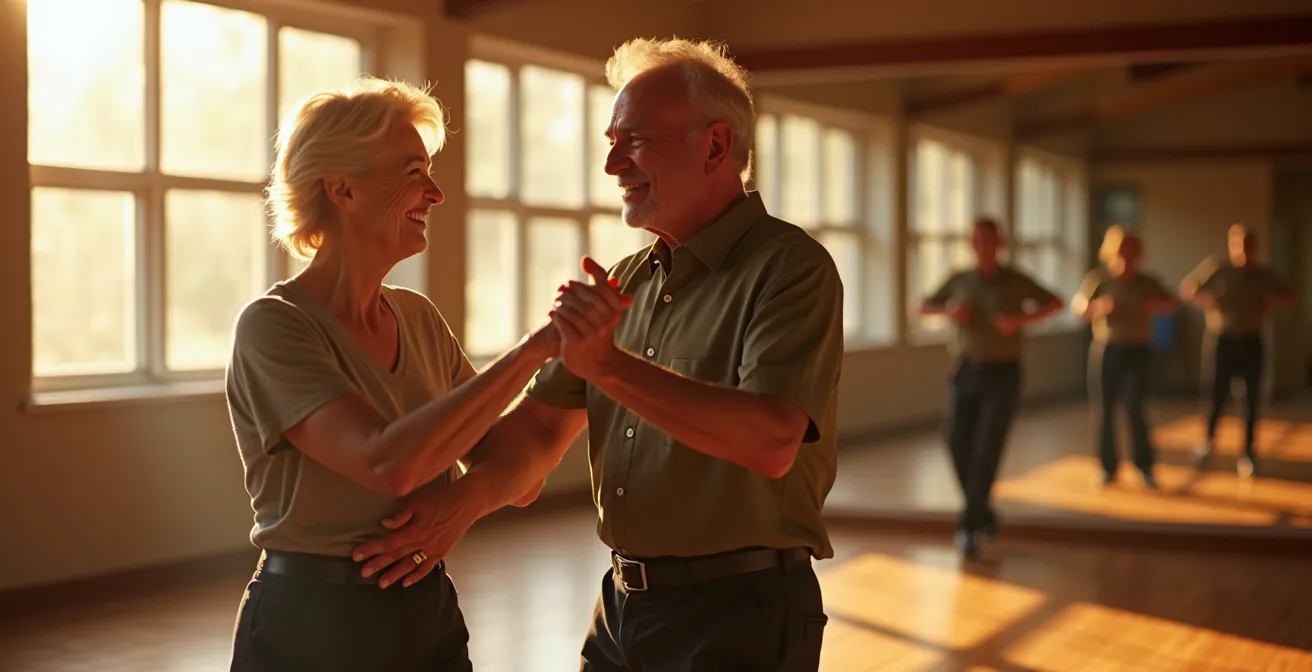
The secret to a younger brain isn’t just exercise; it’s the rhythmic, decision-making challenge of dance.
- Learning steps creates ‘neural scaffolding’ that supports memory and cognitive function.
- This ‘cognitive-motor multitasking’ releases more brain-boosting BDNF than repetitive workouts.
Recommendation: Start with simple, solo ballroom steps to build a powerful mind-body connection and actively grow your brain.
For years, we’ve been told that to keep our minds sharp, we should sit down with puzzles, crosswords, and brain-training apps. We picture cognitive health as a quiet, sedentary activity. But what if the most powerful tool for boosting your brain, specifically the memory-centric hippocampus, wasn’t in a box or on a screen? What if it was waiting on the dance floor, in the rhythm of a waltz, or the swing of a foxtrot?
The conversation around senior wellness often separates body from mind. We walk for our hearts and do sudoku for our heads. This article challenges that division. It’s built on a dynamic premise: the act of coordinating dance steps is a unique form of cognitive-motor multitasking that does more for your brain’s volume and connectivity than most traditional exercises. It’s not just about moving; it’s about moving with intention, rhythm, and constant, split-second decision-making.
Forget the myth that dancing is just for the young or the naturally gifted. We’re going to break down the science, step by step, showing you how this joyful activity becomes a potent neurological workout. We’ll explore the “why” behind the brain-boost, the “how” of mastering simple steps safely, and the “what” of building a routine that serves both your body and mind. It’s time to step into a new understanding of brain health—one that’s filled with music, movement, and life.
This guide provides a complete roadmap, from understanding the brain science to building your own dual-action routine. Explore the sections below to discover how to turn every step into a stride for cognitive vitality.
Summary: A Dancer’s Guide to Boosting Brain Volume and Cognitive Health
- Why Aerobic Exercise Releases BDNF (Miracle-Gro for the Brain)?
- How to Master Basic Ballroom Steps for Cognitive Coordination?
- The Risk of High-Intensity Intervals for Seniors with Heart Conditions
- Aerobic vs Resistance Training: Which Is Better for Executive Function?
- Morning vs Evening Workouts: When is the Brain Most Receptive?
- Yoga or Tai Chi: Which Practice Better Protects Cognitive Function?
- How to Safe-Proof the “One-Leg Stand” Exercise in Your Kitchen?
- How to Build a Dual-Action Routine for Brain and Body Health After 70?
Why Aerobic Exercise Releases BDNF (Miracle-Gro for the Brain)?
Think of your brain as a garden. To grow, it needs fertilizer. For your neurons, that fertilizer is a powerful protein called Brain-Derived Neurotrophic Factor (BDNF). This remarkable molecule is crucial for neurogenesis—the creation of new brain cells—and for building and maintaining the connections between them. When BDNF levels are high, your brain is in a prime state for learning, memory, and repair. And one of the best ways to get your body to produce it is through aerobic movement.
But not all movement is created equal. While any activity that raises your heart rate will trigger some BDNF release, dance introduces a powerful combination of physical, cognitive, and social demands that takes this process to another level. The very act of learning and executing a dance sequence—coordinating your feet with the rhythm, remembering the pattern, and navigating space—is a form of intense enrichment for your brain. This isn’t just theory; it’s backed by compelling evidence. For instance, a 2023 meta-analysis of ten studies involving nearly 1,000 seniors found that dance therapy significantly improved global cognitive function, memory, and executive function.
The key differentiator is the cognitive load. Running on a treadmill is repetitive. Lifting weights follows a predictable pattern. Dancing, however, requires constant adaptation and rhythmic decision-making. This unique challenge appears to be the secret ingredient. In fact, research from a 2018 PLOS One study reveals that while conventional fitness training improves physical fitness, dance interventions lead to significant increases in both BDNF levels and brain volume. Your brain doesn’t just get more blood flow; it gets a direct signal to grow, rebuild, and become more resilient.
How to Master Basic Ballroom Steps for Cognitive Coordination?
The idea of “ballroom dancing” might conjure images of complex, partnered routines. But the brain-boosting power of dance begins with the very first step you learn, even if you’re practicing solo in your living room. The magic lies in building neural scaffolding—creating a new mental framework by connecting music, rhythm, and physical movement. Mastering a simple waltz box step is not just a physical accomplishment; it’s an act of constructing new pathways in your brain.
The key is to approach it methodically, breaking the process down into manageable layers. Don’t try to do everything at once. Start with your body, then the rhythm, then the footwork. This layering technique reduces cognitive overload and allows your brain to form strong, lasting connections for each component of the skill. Using a sturdy chair or kitchen counter for support is not a sign of weakness; it’s a smart strategy to offload the task of balance, allowing you to focus entirely on the coordination of the steps. As your confidence and muscle memory grow, the support becomes less necessary, and the movement becomes fluid and automatic.
This solo practice is a perfect illustration of cognitive-motor multitasking in a safe, controlled environment. You are simultaneously thinking about posture, weight transfer, foot placement, and timing. The following image captures this foundational moment of practice, where the home environment transforms into a personal dance studio.
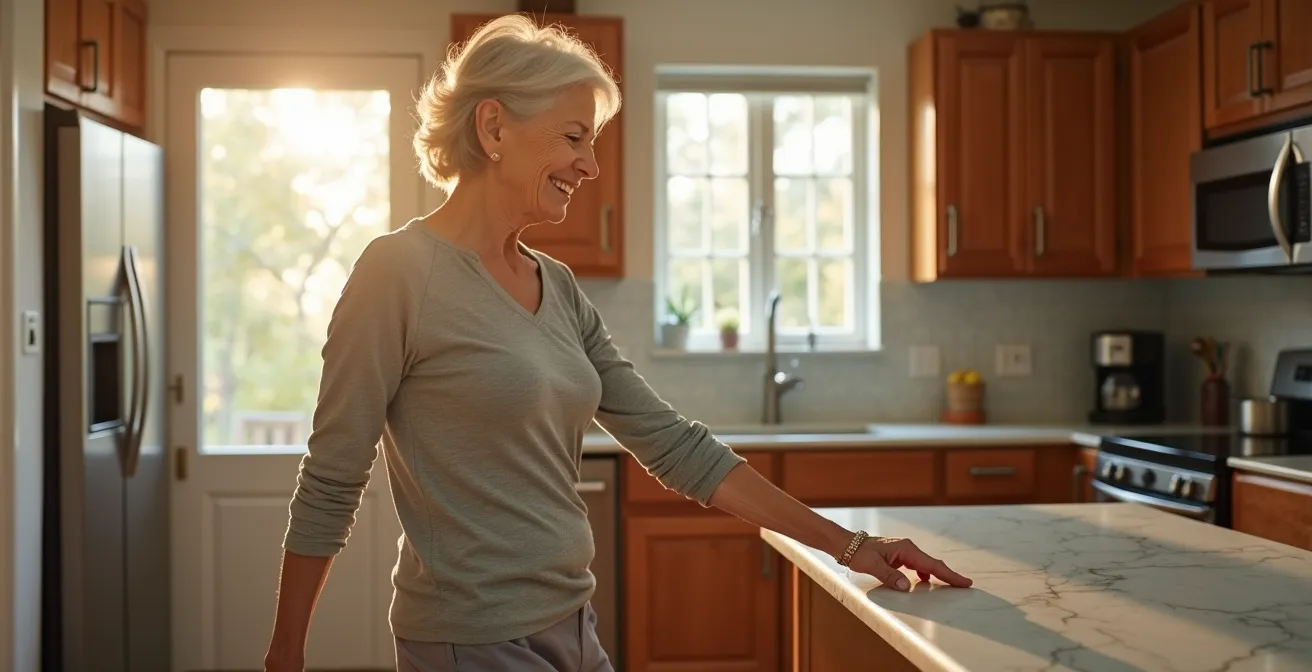
As you can see, the focus is on form and stability. Using tactile guides like masking tape on the floor can be incredibly helpful, giving your brain both visual and proprioceptive feedback. Start without music to master the pattern, then introduce a slow-tempo song. This gradual progression ensures that you are always challenging your brain just enough to stimulate growth without causing frustration. A few minutes of consistent, daily practice is far more effective than one long, overwhelming session per week.
The Risk of High-Intensity Intervals for Seniors with Heart Conditions
The fitness world often glorifies high-intensity interval training (HIIT) as the ultimate workout. However, for many seniors, especially those with pre-existing heart conditions, this “all-out” approach can be more risky than rewarding. HIIT involves short bursts of maximum effort, which can cause rapid spikes in heart rate and blood pressure, placing undue stress on the cardiovascular system. The goal of a brain-healthy exercise routine is sustainability and safety, not pushing your body to its absolute limit.
Dance offers a brilliant alternative: a naturally variable-intensity workout. A slow waltz keeps your heart rate in a steady, moderate zone, while a more upbeat foxtrot can elevate it slightly, all without the jarring shock of a HIIT protocol. The key is to stay within your personal “sweet spot.” For moderate-intensity exercise, the American Heart Association recommends seniors maintain a heart rate between 50-70% of their maximum. This zone is perfect for reaping cardiovascular and cognitive benefits without over-exertion.
The beauty of dance is its inherent adaptability. You are in complete control. Feeling energetic? Add a little more bounce to your step. Need to take it easy? Keep the movements smaller and smoother. There’s no external pressure to “keep up.” This is especially crucial for individuals with cardiac concerns. By focusing on low-impact movements, avoiding sharp, fast twists or jumps, and even utilizing seated dance options, the activity can be tailored to almost any fitness level. Always listen to your body, monitor your breathing, and never push through discomfort or dizziness. Consulting with your doctor before starting any new exercise program is the most important first step.
Aerobic vs Resistance Training: Which Is Better for Executive Function?
For decades, the fitness debate has often pitted aerobic exercise (like walking) against resistance training (like lifting weights). Aerobics were for the heart, and weights were for the muscles. But when the goal is boosting executive function—the brain’s command center responsible for planning, problem-solving, and decision-making—the answer is not one or the other. It’s the synthesis of both, and this is where dance shines.
Ballroom dancing is a unique hybrid activity. It is fundamentally aerobic, keeping your heart rate elevated and improving cardiovascular health. Yet, it also incorporates elements of resistance training. Every step requires you to work against gravity, control your own body weight, and maintain posture and frame, which engages core and leg muscles. This dual-action nature is what makes it so effective for the brain. While treadmill walking offers modest cognitive gains and resistance training primarily supports brain health by improving glucose regulation, dancing directly trains the executive functions it seeks to improve.
This is the core of cognitive-motor multitasking: your brain is not just telling your body to move; it’s engaged in a constant, rapid-fire decision-making process. “Should I step forward or to the side? Am I on the beat? Where is my partner?” This is a world away from the linear, predictable nature of walking on a treadmill. The table below illustrates how dancing integrates the benefits of multiple exercise types.
| Exercise Type | Cognitive Benefits | Physical Benefits | Social Component |
|---|---|---|---|
| Ballroom Dancing | Improved executive function, processing speed, memory | Balance, coordination, cardiovascular health | High – partner interaction required |
| Treadmill Walking | Modest improvements in executive function | Cardiovascular endurance, lower body strength | Low – typically solo activity |
The synergy between different types of physical stress—aerobic and resistance—creates a richer, more complex stimulus for your brain. By integrating these elements within a single, enjoyable activity, you are building a more resilient, adaptable, and efficient cognitive system. The activity itself becomes the training.
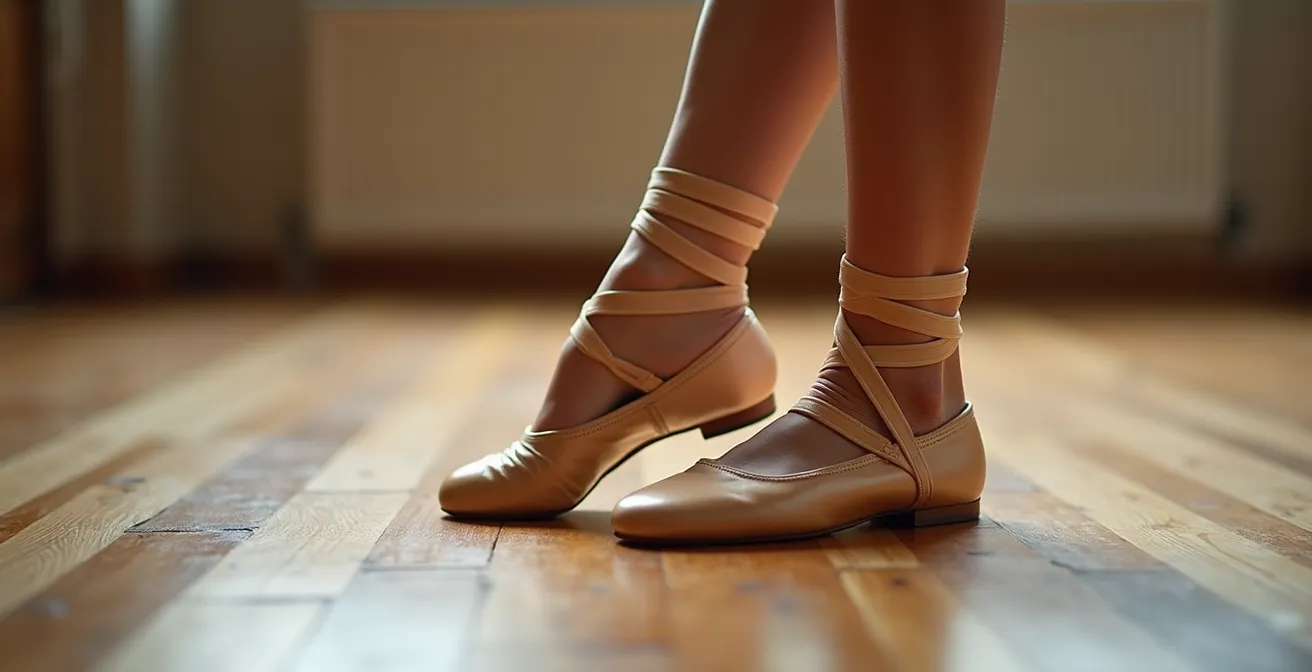
Even when practicing solo, you are engaging in this dual-action workout. The simple act of maintaining a strong frame and executing precise steps is a form of isometric and bodyweight resistance training that complements the aerobic nature of the movement, creating a holistic workout for both brain and body.
Morning vs Evening Workouts: When is the Brain Most Receptive?
Is it better to dance at dawn or dusk? The answer isn’t a simple “yes” or “no”—it depends on your goal. Your brain’s chemistry and receptiveness to learning fluctuate throughout the day, and you can leverage these natural rhythms to maximize the cognitive benefits of your dance practice. The key is to align your activity with your biological state.
Morning sessions are ideal for learning new material. This is when your levels of cortisol, the “alertness” hormone, are naturally at their peak. A higher cortisol level can enhance focus and improve the brain’s ability to acquire complex new information. So, if you’re tackling a brand-new step or a challenging sequence, doing it in the morning can help you pick it up faster. A 2017 Frontiers study highlighted this very effect, finding that participants who learned new dance routines in the morning showed better acquisition of complex sequences.
Evening sessions, on the other hand, are perfect for consolidation and refinement. As the day winds down, your brain shifts into a state that is more conducive to memory consolidation—the process of converting short-term memories into long-term ones. Practicing steps you’ve already learned in the evening can help cement them in your memory, improving long-term retention and making the movements feel more automatic and fluid. The same study noted that dancers practicing familiar routines in the evening demonstrated superior long-term retention. Think of it this way: learn in the morning, perfect in the evening. This creates a powerful cycle of acquisition and consolidation that accelerates your progress and deepens the neural pathways you’re building.
Yoga or Tai Chi: Which Practice Better Protects Cognitive Function?
Yoga and Tai Chi are fantastic practices for seniors. They are celebrated for their ability to improve balance, reduce stress, and enhance mindfulness. Both involve a deep mind-body connection and have been shown to offer protective cognitive benefits. They teach body awareness, control, and focused breathing—all valuable components of a healthy lifestyle. However, when the specific goal is to build maximum cognitive reserve and stave off dementia, dance introduces a unique and powerful element that these other practices often lack: rhythmic, rapid-fire decision-making under pressure.
While Yoga involves holding poses and Tai Chi follows a slow, prescribed form, social dancing requires constant, real-time adaptation. You must react to the music, your partner, and other couples on the floor. This improvisational nature forces your brain to stay incredibly active, creating and strengthening neural connections on the fly. It’s this specific challenge—the cognitive-motor multitasking of processing music, space, and movement simultaneously—that appears to provide an unparalleled level of neuroprotection.
The evidence is striking. A landmark 2003 New England Journal of Medicine study followed seniors for over 20 years, tracking the cognitive effects of 11 different physical activities. While activities like swimming and bicycling had no statistically significant effect on dementia risk, and reading reduced the risk by 35%, frequent dancing was in a class of its own. The study found that regular social dancing was associated with a 76% reduced risk of dementia—the greatest risk reduction of any activity studied, physical or cognitive. This suggests that while mindful practices like Yoga and Tai Chi are beneficial, the rich, multi-sensory, decision-heavy environment of dance offers a superior stimulus for building a resilient brain.
How to Safe-Proof the “One-Leg Stand” Exercise in Your Kitchen?
Balance is not something we think about until we start to lose it. Yet, it is a critical skill that relies on a constant, high-speed conversation between your brain, inner ear, eyes, and muscles. The one-leg stand is a fundamental exercise for strengthening this system, but it can feel intimidating. The kitchen, with its sturdy countertops, provides the perfect safe space to practice and progressively challenge your balance system. Safe-proofing this exercise is about creating a controlled environment where you can push your limits without risking a fall.
The first rule is to always have a support within reach. Start by holding the counter with both hands. As you get stronger, progress to one hand, then to a few fingertips, and eventually to just hovering your hand an inch above the surface. This creates a safety net, giving your brain the confidence to fully engage in the balance challenge. The goal is not to avoid using support, but to gradually need it less.
But to truly turn this physical exercise into a brain-boosting workout, you must add a cognitive layer. This is where the concept of “dual-tasking” comes in. Once you are relatively stable on one leg, challenge your brain with a mental task. Count backwards from 100 by sevens. Name fruits alphabetically. Recite a poem from memory. This forces your brain to divide its attention, strengthening both your balance and your cognitive flexibility. This dual-task training directly mimics the demands of real-world situations, like walking while holding a conversation, which is often when falls occur.
Your Action Plan: The Progressive Balance Protocol
- Week 1: Stand on one leg holding the counter with both hands for 30 seconds.
- Week 2: Progress to one-hand support while counting backwards from 100 by 7s.
- Week 3: Use only two fingertips for support while naming fruits alphabetically.
- Week 4: Hover your hand 1 inch above the counter while reciting a memorized poem.
- Advanced: Place a folded towel under your standing foot to create an unstable surface.
By following a progressive protocol, you are building your balance skills on a solid foundation. Each step provides a new challenge for your proprioceptive system, making the neural dialogue between your body and brain faster, clearer, and more efficient.
Key Takeaways
- Dance is more than physical activity; it’s a form of ‘cognitive-motor multitasking’ that builds new neural pathways.
- The combination of aerobic movement, coordination, and rhythmic decision-making in dance leads to significant increases in brain-boosting BDNF.
- A safe and effective dance routine for seniors prioritizes moderate intensity and low-impact movements over high-intensity intervals.
How to Build a Dual-Action Routine for Brain and Body Health After 70?
We’ve explored the why, the how, and the when. Now, let’s bring it all together. Building a dual-action routine for brain and body health isn’t about exhausting yourself with hours of exercise. It’s about creating a consistent, varied, and joyful schedule that weaves together different types of movement to provide a holistic stimulus. The goal is to create a symphony of activities where each one complements the others, building your cognitive and physical resilience day by day.
A smart routine balances high cognitive load activities with periods of refinement and rest. For example, dedicate your morning sessions, when your brain is most alert, to learning new steps. This is your “high-intensity” brain workout. In the evenings, switch to practicing and refining what you’ve learned, helping to consolidate those new skills into your long-term memory. As the neurologist Dr. Robert Katzman of the Albert Einstein College of Medicine famously noted:
Freestyle social dancing, such as foxtrot, waltz and swing, requires constant split-second, rapid-fire decision making, which is the key to maintaining intelligence because it forces your brain to regularly rewire its neural pathways.
– Dr. Robert Katzman, Neurologist, Albert Einstein College of Medicine
Your weekly schedule should also incorporate other supportive practices. Light resistance training with bands builds the muscle strength needed for good posture and powerful movement. Mindful practices like Tai Chi or Yoga improve the foundational balance and body awareness essential for safe dancing. A complete routine is not just about dance; it’s about building a complete ecosystem of wellness. For instance, a balanced week could look like this:
- Monday (Morning): 30 minutes of learning new solo dance steps (high cognitive load).
- Tuesday (Afternoon): 20 minutes of light resistance training with bands.
- Wednesday (Evening): 30 minutes of practicing and refining learned steps with music.
- Thursday (Morning): 20 minutes of Tai Chi for balance preparation.
- Friday (Afternoon): 45 minutes of social dancing or free-form movement to music you love.
- Saturday & Sunday: Rest, gentle walking, or stretching.
This approach ensures you are constantly challenging your brain and body in different ways, preventing plateaus and making exercise a source of continuous engagement and joy. The most important principle is consistency. A little movement every day is far more powerful than a heroic effort once a week.
Start today by choosing one simple step, putting on your favorite music, and allowing your body and brain to enter into the powerful dialogue of dance. This is the first step in composing your own symphony of lifelong cognitive and physical vitality.
Frequently Asked Questions About Senior Dance Exercise
Can seniors with heart conditions safely participate in dance?
Yes, when movements are low-impact and performed at a comfortable pace. Medical clearance is recommended, and participants should maintain a slow pace while monitoring breathing.
What modifications make dance safer for cardiac patients?
Reduce range of motion, choose seated options, avoid jumps or fast twisting movements, and keep intensity in the moderate zone (50-70% of maximum heart rate).
How long should dance sessions last for seniors with health concerns?
Sessions can last 10-30 minutes depending on fitness level, with the option to take breaks as needed. Listening to your body is the most important guideline.