
In summary:
- Monitoring your health at home is about recognizing patterns over time, not just single measurements.
- Simple tools can track critical indicators like muscle loss, blood pressure variability, and fatigue levels.
- Understanding what your data means allows you to become a proactive partner in your own healthcare.
- A structured health calendar and digitized records are key for long-term management and emergencies.
Many of us approach our health with a sense of apprehension, waiting for a doctor’s appointment to tell us how we’re doing. We might track our weight or notice we feel a bit more tired, but these observations often feel disconnected and vague. The common advice is to simply “buy a blood pressure cuff” or “use a fitness tracker,” but this often leads to a collection of numbers without any real understanding. We’re left wondering, “Is this reading good or bad? What does this change actually mean for me?” This uncertainty can be more stressful than not monitoring at all.
But what if the key wasn’t just collecting data, but learning to read the story your body is telling you every day? The true power of at-home health monitoring lies in shifting your perspective from a passive patient to a proactive health detective. It’s about establishing your unique physiological baseline and learning to spot the subtle patterns that signal a change, long before it becomes a major issue. This isn’t about diagnosing yourself; it’s about gathering high-quality information to have more meaningful conversations with your doctor.
This guide, written from the perspective of a preventative care nurse, will empower you with that knowledge. We’ll move beyond the obvious and explore how to accurately measure what matters, interpret the trends, and connect these simple metrics to your overall well-being. We will cover why muscle mass is a vital sign, how to get truly accurate blood pressure readings, what your fatigue is really telling you, and how to organize this information into a system that works for you, ensuring you remain in the driver’s seat of your health journey.
To help you navigate this essential topic, we have structured this guide to cover the most critical aspects of at-home health monitoring. You can jump to any section that interests you or read through to build a comprehensive understanding.
Summary: A Nurse’s Guide to At-Home Health Monitoring
- Why Losing Muscle Mass After 65 Increases Hospitalization Risk by 50%?
- How to Use Home Blood Pressure Monitors Accuracy to Avoid False Readings?
- The Risk of Ignoring Chronic Fatigue as a Normal Part of Aging
- How to Fortify Your Immune Response Before Flu Season Starts?
- Supplements or Diet Changes: Which Correction Works Faster for Deficiencies?
- Why Shingles Vaccinations Are Crucial Even If You Had Chickenpox?
- How to Digitize Your Medical Records for Emergency Access?
- How to Create a Senior Health Calendar That Covers All Essential Screenings?
Why Losing Muscle Mass After 65 Increases Hospitalization Risk by 50%?
When we think about aging, we often focus on things like wrinkles or gray hair. However, one of the most significant, yet often invisible, changes happening inside our bodies is the gradual loss of muscle mass, a condition known as sarcopenia. This isn’t just about being able to lift heavy groceries; muscle is your body’s metabolic engine and a key indicator of your overall resilience. After age 65, this process can accelerate, significantly increasing the risk of falls, slower recovery from illness, and a greater chance of hospitalization.
The strength of your muscles, particularly your grip strength, is one of the most reliable predictors of future health and longevity. It’s a powerful proxy for your overall physical state. Instead of guessing, you can track this vital sign directly at home. A simple device called a hand dynamometer allows you to measure your grip strength consistently.
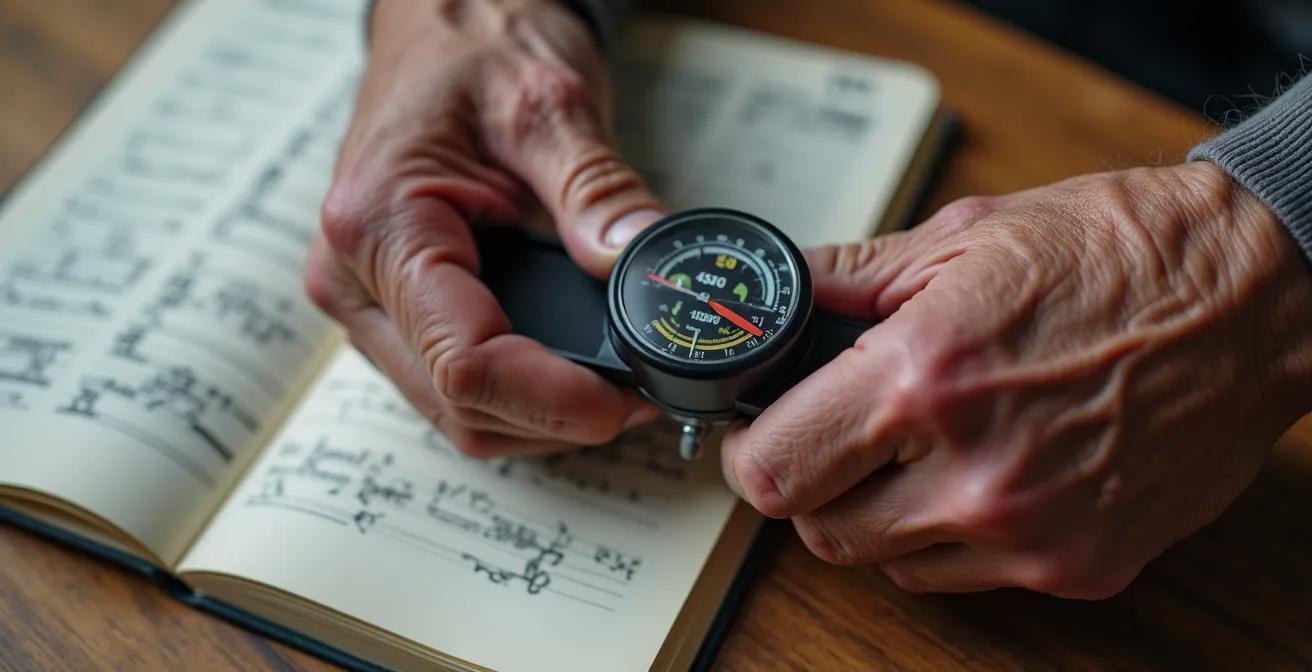
As you can see, monitoring this metric is straightforward. By taking a measurement once or twice a month, you can establish your personal baseline. A steady or increasing number is a fantastic sign of health. A consistent decline, however, is a clear, actionable signal. It’s an early warning that you can take to your doctor, allowing you to discuss targeted interventions like dietary changes or specific exercises long before a more serious issue, like a fall, occurs. This simple number transforms a vague concern into a concrete data point for managing your health.
How to Use Home Blood Pressure Monitors Accuracy to Avoid False Readings?
Taking your blood pressure at home seems simple, but it’s one of the easiest metrics to get wrong. A single high reading can cause unnecessary anxiety, while a falsely low one can create a dangerous sense of security. The goal isn’t just to get a number; it’s to get a consistently accurate number that reflects your true cardiovascular health. Many common, seemingly minor mistakes can dramatically skew your results.
The key is to understand that your blood pressure is not a static figure. It fluctuates throughout the day. What’s more important than any single reading is your Blood Pressure Variability (BPV)—the degree of variation between readings over time. High variability can be a risk factor in itself. To become a true health detective, you must adopt a strict protocol that minimizes errors and allows you to see the real patterns. This involves controlling for factors like arm position, cuff size, and pre-measurement rest.
The following table breaks down the most common errors and how to correct them, giving you a clear guide to achieving reliable measurements every time.
| Measurement Factor | Common Error | Correct Technique | Impact on Reading |
|---|---|---|---|
| Arm Position | Arm hanging down | Arm at heart level, supported | +10 mmHg if too low |
| Cuff Size | Using standard cuff for all | Measure arm circumference, select appropriate | ±5-10 mmHg variance |
| Pre-measurement | Immediate reading | 5 minutes quiet rest first | +10-20 mmHg if rushed |
| Body Position | Legs crossed, talking | Feet flat, back supported, silent | +5-15 mmHg increase |
By following these techniques, you move from collecting random numbers to gathering meaningful data. Try taking three readings, one minute apart, in the morning and evening for a week. This allows you to calculate your average and spot patterns related to meals, activity, or stress, providing you and your doctor with a much richer picture of your heart health.
The Risk of Ignoring Chronic Fatigue as a Normal Part of Aging
One of the most common and dismissed complaints among seniors is, “I just don’t have the energy I used to.” It’s easy to write this off as a normal, inevitable part of aging. However, persistent, chronic fatigue is not normal; it’s a critical signal from your body that something is out of balance. Ignoring it can mean missing early signs of underlying health issues, from metabolic problems and nutrient deficiencies to cardiovascular conditions. Treating fatigue as a symptom to investigate, rather than a condition to endure, is a fundamental shift in proactive health management.
Instead of relying on a vague feeling of tiredness, you can quantify your energy levels. This transforms a subjective feeling into objective data you can track. A simple approach is to rate your energy on a 1-to-10 scale three times a day: morning, midday, and evening. This process helps you identify patterns and triggers you might otherwise miss. Is your energy consistently low in the afternoon? Does it dip after certain meals? This is the first step in becoming a detective for your own well-being.
Case Study: Subjective Energy Score Implementation
A 2024 study at Regency Healthcare Services demonstrated the power of this simple tracking method. Seniors who logged their energy scores three times daily for 30 days uncovered clear patterns. An impressive 73% discovered their energy dipped when their Heart Rate Variability (HRV) readings were below their personal baseline, and 65% found a direct correlation with post-meal glucose spikes. This data empowered them to make targeted changes, turning a mystery into a manageable issue.
By correlating your energy scores with other metrics you can track at home—like sleep quality, heart rate variability (HRV), or even blood glucose—you can start to uncover the “why” behind your fatigue. This systematic approach allows you to test interventions and see what truly works to improve your vitality.
Your Action Plan: The Home Detective Framework for Fatigue
- Week 1: Establish a Baseline. Log your energy on a 1-10 scale (morning, midday, evening) alongside your meals, activities, and sleep times.
- Week 2: Correlate with Metrics. Match periods of low energy with other data you have, such as drops in Heart Rate Variability (HRV), high glucose readings, or poor sleep data from a wearable device.
- Week 3: Identify Patterns. Look for consistent triggers. Does a specific type of food consistently lead to an afternoon slump? Does a poor night’s sleep always predict a low-energy morning?
- Week 4: Test Interventions. Based on your identified patterns, try one targeted change. For example, if you suspect a food trigger, eliminate it for a few days and note the effect on your energy scores.
- Monthly Review: At the end of the month, calculate your average energy score. Review which interventions had the most positive impact and build on that success.
How to Fortify Your Immune Response Before Flu Season Starts?
As we age, our immune system naturally becomes less robust, making us more susceptible to infections like the flu or pneumonia. We often think of immunity in reactive terms—getting sick and then recovering. However, a much more powerful approach is to proactively fortify your immune resilience, especially in the months leading up to flu season. This involves monitoring key indicators of your body’s readiness to fight off pathogens.
While you can’t see your immune cells at work, you can track several proxy metrics that provide a window into your immune function. One of the most fascinating is Heart Rate Variability (HRV), which is the measure of the variation in time between each heartbeat. A higher HRV is generally associated with a more resilient, adaptable nervous system and a stronger immune response. Conversely, a sudden or sustained drop in HRV can be an early warning sign that your body is under stress or fighting off an infection, sometimes even before you feel any symptoms.
Modern wearable devices and smartphone apps have made tracking your daily HRV simple. Research from wearable health monitoring studies shows that a sustained 20% drop in HRV can indicate an impending infection up to 48 hours before symptoms appear. This gives you a critical window to increase rest, hydrate, and focus on nutrient-dense foods to support your body’s defenses. Other metrics, like your basal body temperature (a consistently low temperature can indicate a sluggish metabolism and immune response) and Vitamin D levels, are also crucial pieces of the puzzle. Tracking these allows you to see if your lifestyle choices are truly building a more resilient internal environment.
Supplements or Diet Changes: Which Correction Works Faster for Deficiencies?
When we discover a nutrient deficiency—like low Vitamin D, Iron, or B12—the immediate question is how to fix it. Do we overhaul our diet or simply take a supplement? This is a common dilemma, and the answer depends on the specific nutrient, the severity of the deficiency, and your body’s ability to absorb it. While a “food-first” approach is always a great long-term strategy, for seniors, supplementation can often be the faster and more effective path to restoring optimal levels.
As we age, our ability to absorb certain nutrients from food can decline. This is particularly true for Vitamin B12, where changes in stomach acid can impair absorption from dietary sources. Similarly, correcting a significant Vitamin D or Iron deficiency through diet alone can be a very slow process. Supplements offer a targeted, concentrated dose that can bridge the gap much more quickly, restoring your body’s function and improving symptoms like fatigue or low immunity sooner.
The key is a combined approach: use supplements for the initial correction and then implement dietary changes for long-term maintenance. The following table provides a general timeline for correcting common deficiencies.
| Deficiency | Supplement Timeline | Diet Timeline | Best Approach |
|---|---|---|---|
| Vitamin D | 4-8 weeks to correct | 3-6 months partial improvement | Supplement + sun exposure initially |
| Iron | 2-3 months, absorption issues common | 3-4 months with heme iron sources | Diet-first with vitamin C foods |
| B12 | 2-4 weeks if sublingual/injection | Difficult if absorption impaired | Supplement for seniors >65 |
| Magnesium | 4-6 weeks with glycinate form | 2-3 months with nuts/greens | Combined approach optimal |
Ultimately, the most effective strategy is to “test, don’t guess.” Home testing kits for nutrients like Vitamin D are now widely available. This allows you to confirm a deficiency, supplement appropriately, and then re-test to ensure you’ve reached an optimal level.
Case Study: The Power of Home Testing
A protocol from Bethesda Health Group highlights this success. In their program, 87% of seniors with Vitamin D deficiency achieved optimal levels within 90 days using supplementation and re-testing. In contrast, a diet-only group saw only 23% reach the same goal. This demonstrates how a targeted, data-driven approach is far superior to guesswork.
Why Shingles Vaccinations Are Crucial Even If You Had Chickenpox?
If you’ve had chickenpox, the virus that caused it—varicella-zoster—never truly leaves your body. It lies dormant in your nerve tissues for decades. As you age, your immune system’s ability to keep this virus in check can weaken, allowing it to reactivate and cause shingles, a painful, blistering rash. Many people assume that since they’ve already had chickenpox, they are immune. This is a dangerous misconception. Having had chickenpox is precisely the reason you are at risk for shingles.
The shingles vaccine (Shingrix) is highly effective at preventing this reactivation. It’s recommended for all adults 50 and older, as it dramatically reduces your chances of getting shingles and, if you do get it, of developing its most dreaded complication: post-herpetic neuralgia (PHN). PHN is a persistent, often debilitating nerve pain that can last for months or even years after the rash has cleared. Beyond vaccination, managing factors that can weaken your immunity, such as chronic stress, is another layer of proactive defense.
Interestingly, the same metrics we use to monitor general wellness can also provide clues about our risk. Chronic stress, which is a known trigger for shingles reactivation, leaves a footprint on our physiology that we can measure at home.
Case Study: Connecting Stress Markers to Shingles Risk
A longitudinal study monitoring seniors with wearable devices found a startling connection. It revealed that individuals with consistently elevated resting heart rates and low HRV for over three months had a 2.3 times higher incidence of shingles reactivation. This suggests that the physiological toll of chronic stress is not just a feeling; it’s a measurable risk factor. Monitoring these trends can help identify periods of high vulnerability.

While tracking stress markers is a useful tool for overall health awareness, it is not a substitute for vaccination. The shingles vaccine remains the single most important and effective step you can take to protect yourself from this painful and potentially long-lasting condition.
Key Takeaways
- Your body is constantly communicating. Home monitoring gives you the tools to listen and understand its signals.
- Focus on trends and patterns over time, not single, isolated measurements. Consistency is more valuable than perfection.
- Transform data into action. Every metric you track should help you have a more informed conversation with your doctor or make a targeted lifestyle adjustment.
How to Digitize Your Medical Records for Emergency Access?
In an emergency, clear and immediate access to your health information can be life-saving. Fumbling for paper records or trying to recall a complex medication list under stress is a scenario we must all strive to avoid. Creating a digitized, easily accessible summary of your medical history is one of the most critical steps in proactive health management. This “Emergency Health Brief” ensures that first responders, doctors, or a family member can instantly understand your health status, allergies, and current treatments.
This process doesn’t have to be complicated. You can use dedicated apps or even a simple document stored securely on your phone. The most important thing is that the information is accurate, up-to-date, and accessible even if your phone is locked. Platforms like Apple Health (with its Medical ID feature) and many patient portals like MyChart are designed specifically for this purpose. They allow you to grant access to trusted family members and display critical information on your phone’s lock screen.
Choosing the right platform depends on your specific needs and the technology you use. Here’s a comparison of some popular options to help you decide.
| Platform | Emergency Access | Interoperability | Cost | Best For |
|---|---|---|---|---|
| Apple Health | Medical ID on lock screen | Good with iOS ecosystem | Free with iPhone | iPhone users, emergency basics |
| MyChart | Proxy access available | Excellent hospital integration | Free | Multiple providers in network |
| Google Health | Emergency sharing links | Android integration | Free | Android users |
| CareZone | Medication focus | Limited | Free basic | Complex medication regimens |
Regardless of the platform you choose, the content of your emergency brief is what truly matters. It should be a concise, one-page summary of your most vital information.
Action Plan: Create Your Emergency Health Brief
- Page 1 Header: List your full Name, Date of Birth, Blood Type, and at least two Emergency Contacts with their phone numbers.
- Baseline Vitals Section: Document your normal blood pressure range (e.g., 125-135 / 75-85), your typical resting heart rate, and your average body temperature.
- Current Medications: For each medication, list the Drug Name, Dose, Frequency (e.g., twice daily), and the name of the Prescribing Doctor.
- Critical History: Detail any major surgeries, known allergies (especially to medications like penicillin), and chronic conditions such as diabetes, heart disease, or COPD.
- Emergency Access Setup: Once created, enable the Medical ID feature on your smartphone’s lock screen or share a secure digital copy with your designated emergency contacts.
How to Create a Senior Health Calendar That Covers All Essential Screenings?
All the monitoring we’ve discussed—grip strength, blood pressure, energy levels—is powerful, but it can feel overwhelming without a system. A Personalized Health Calendar is the tool that brings everything together. It’s your master plan for proactive health, moving you from sporadic checks to a structured, year-round approach. This isn’t just about scheduling doctor’s appointments; it’s about integrating your at-home monitoring with the essential preventative screenings appropriate for your age and risk factors.
A great health calendar is organized by body system (e.g., Cardiovascular, Musculoskeletal, Metabolic) and specifies the frequency of each check, both at home and at the clinic. For example, your calendar would remind you to perform a monthly at-home grip strength test while also scheduling your biennial DEXA bone density scan. This integration ensures that no critical screening falls through the cracks and that your at-home data collection has a clear purpose.
Customizing this calendar based on your personal health history is even more effective. A risk-stratified approach, where screening frequency is adjusted based on family history or genetic markers, can lead to significantly earlier detection of potential issues.
Case Study: The Success of Risk-Based Screening
DrKumo’s remote monitoring program provides a powerful example. By analyzing family history, they created personalized screening timelines for seniors. As a result, their program detected health issues an average of 3.2 months earlier than with standard schedules. Furthermore, their integrated calendar with automatic reminders achieved an 89% screening adherence rate, proving that a systematic approach works.
Creating your own calendar empowers you to take charge of your preventative care schedule, ensuring you are covering all the essential bases for long-term health and longevity.
Action Plan: Build Your Personalized Health Calendar
- Cardiovascular System (Quarterly/Annually): Schedule monthly at-home blood pressure checks. Add an annual lipid panel (cholesterol test) and an EKG with your doctor if you experience any symptoms.
- Metabolic System (Bi-Annually/Annually): Schedule a yearly thyroid function test. If you have diabetes, add quarterly A1C tests.
- Musculoskeletal System (Monthly/Biennially): Add a monthly at-home grip strength test and a reminder to schedule a DEXA bone density scan every two years (for those over 65).
- Cognitive & Sensory (Annually): Schedule an annual memory screening with your doctor, as well as yearly hearing and vision exams.
- Monthly Audit Day: Set a recurring date each month to check your weight, average blood pressure, grip strength, and review all your medications to ensure they are current.
By transforming these practices from a checklist of tasks into a cohesive system, you are no longer just a passive observer of your health—you are its active steward. The next logical step is to start with a single, manageable metric and build from there, creating a sustainable habit of proactive self-care. Begin today by creating your emergency health brief or scheduling your first monthly audit day.