Choosing a stairlift for a curved or narrow staircase is a structural engineering decision, not a simple appliance purchase.
- The primary cost driver is the custom-fabricated rail required for curved stairs, which has virtually zero resale value.
- Modern stairlifts attach to the stair treads, not walls, but require specific safety features like swivel seats to prevent falls during dismount.
Recommendation: Begin by assessing your entire home’s mobility pathway, not just the staircase, to create a comprehensive and safe long-term solution.
The thought of leaving your home because the stairs have become an insurmountable obstacle is a deeply unsettling prospect. For many, navigating a narrow or curved staircase feels like a daily risk, eroding confidence and independence. The common advice is to simply “get a stairlift,” but this often overlooks the critical technical nuances that separate a safe, long-term solution from a costly mistake. The decision is rarely just about the chair itself; it involves understanding the engineering, the structural requirements of your home, and the specific safety protocols needed to truly reclaim your space.
This is not just about buying a piece of equipment. It’s about undertaking a strategic home integration project. The real key to success lies not in comparing brand names, but in understanding the core engineering principles that guarantee safety and viability for your home’s unique layout. This guide moves beyond the surface-level features to delve into the structural, financial, and safety-critical aspects you must consider. We will analyze why custom rails are so expensive, when renting makes financial sense, and which specific features are non-negotiable for preventing the most common types of falls.
By focusing on the “why” behind the technology, you can transform a “stair problem” into a permanent, reliable mobility solution, ensuring you can continue to live safely and comfortably in the home you love.
This article provides a detailed breakdown of the essential factors to consider, from the mechanics of the rail system to the critical safety features that protect you at every stage of your journey. Explore the sections below to build a complete understanding of this important investment.
Summary: A Technical Guide to Stairlifts for Complex Staircases
- Curved vs Straight Rails: Why Custom Bends Cost 3x More?
- Renting a Stairlift: When Does It Make Financial Sense?
- The Risk of Weak Walls: Structural Requirements for Installation
- Swivel Seats and Sensors: Which Features Prevent Dismount Falls?
- Used Stairlifts: Why They Are Hard to Sell Second-Hand?
- Why 90% of Hip Fractures Are Caused by Indoor Falls?
- When to Request a DEXA Scan: Guidelines for Men and Women Over 65
- How to Widen a Doorway Without Moving Load-Bearing Walls?
Curved vs Straight Rails: Why Custom Bends Cost 3x More?
The single most significant factor determining the cost and complexity of a stairlift is the geometry of its rail. The distinction between a straight and a curved installation is not a minor detail; it represents a fundamental difference in manufacturing, engineering, and long-term value. A straight stairlift rail is a standardized, mass-produced component. It’s manufactured in sections and simply cut to the required length on-site. This efficiency makes it relatively affordable.
In stark contrast, a curved rail is a bespoke piece of engineering. Each bend, turn, and gradient change of your staircase must be precisely measured, often using photogrammetry, to create a digital model. This model guides the fabrication of a unique rail that hugs every contour of your specific stairway. This is not an assembly-line product; it is a hand-crafted component built for one home and one home only. This custom fabrication process is why costs can be dramatically higher, with prices for curved models often starting where straight models top out.
This table clearly outlines the trade-offs between the two systems, highlighting that the initial investment for a curved lift is tied to its bespoke manufacturing process. The price difference reflects a shift from a standardized product to a custom-made structural solution for your home.
| Feature | Straight Stairlift | Curved Stairlift |
|---|---|---|
| Price Range | $2,500-$8,000 | $11,000+ |
| Rail Type | Standardized, cut to fit | Custom fabricated |
| Installation Time | 2-4 hours | 4-8 hours + fabrication time |
| Resale Value | Moderate (reusable rail) | Near zero (custom rail) |
| Manufacturing Process | Mass produced | Hand-crafted to specifications |
Understanding this distinction is the first step in financial planning. The higher price of a curved stairlift, which can range from $12,000 to $20,000 compared to $3,000 to $7,000 for a straight one, is a direct result of the intensive, made-to-order labor and precision engineering involved.
Renting a Stairlift: When Does It Make Financial Sense?
Given the significant upfront cost of purchasing a stairlift, particularly a curved model, renting can appear to be an attractive alternative. However, the decision to rent versus buy should be a calculated one, based on a clear understanding of your expected timeline and the total cost of ownership. Renting is primarily a short-term solution, best suited for temporary mobility needs, such as post-surgery recovery or accommodating a visiting relative for a few months. The financial break-even point is a critical calculation.

The costs of renting can accumulate quickly. According to market data, you can expect to pay between $300 to $500 per month for a rental, but that’s not the full picture. Most rental agreements come with significant one-time fees, including an installation fee ($400-$700) and a removal fee ($300-$600) once the contract ends. Many companies also require a minimum rental period, often three months, meaning your initial outlay could be well over $1,500 before you even begin. A simple calculation often reveals that if the need for the stairlift extends beyond 18-24 months, purchasing becomes the more economical option.
Furthermore, it’s important to be aware of potential hidden costs. A refundable security deposit is standard, and you will likely be liable for any repairs due to damage or misuse. Missed appointment fees can also be charged if the installer cannot access the property as scheduled. For curved staircases, rental options are far less common and significantly more expensive due to the custom nature of the rail. In most cases, renting is only feasible for straight staircases where the equipment is standardized and reusable.
The Risk of Weak Walls: Structural Requirements for Installation
A pervasive myth about stairlift installation is that it requires strong, reinforced walls to support the unit’s weight. This is a common source of anxiety for homeowners, who worry about the need for disruptive and expensive structural modifications. The reality of modern stairlift engineering is far simpler and less invasive. The fundamental principle of installation is that the lift is supported by the staircase itself, not the adjacent wall. This is a critical point that provides significant peace of mind.
Installation technicians use specialized brackets to affix the rail’s support posts directly onto the stair treads—the flat surfaces you step on. The load of the chair and its occupant is therefore transferred down through the staircase structure, which is already designed to bear significant weight. Installation data confirms that over 95% of modern stairlifts attach directly to stair treads, making wall condition a non-issue in the vast majority of cases. This method applies to staircases made of wood, concrete, or even metal, as long as the appropriate fasteners are used.
The only time a wall might be used for support is in rare situations where the stair treads are made of a fragile material or are in poor condition. In such cases, a technician might use wall-mounted brackets as a secondary stabilization point, but this is the exception, not the rule. The focus of a structural assessment is therefore on the integrity of the treads and the overall stability of the staircase, not the plasterboard or paneling on the wall next to it. This design ensures that installation is a clean, efficient process that preserves the integrity of your home’s walls.
Swivel Seats and Sensors: Which Features Prevent Dismount Falls?
While the rail system is the backbone of a stairlift, the design of the seat and its integrated safety features are what ensure a safe journey from start to finish. The most vulnerable moments for any user are getting on and off the chair. A well-engineered stairlift incorporates specific technologies to mitigate the risks associated with these transfers, particularly at the top of the stairs where the fall risk is highest. The most critical of these is the swivel seat.
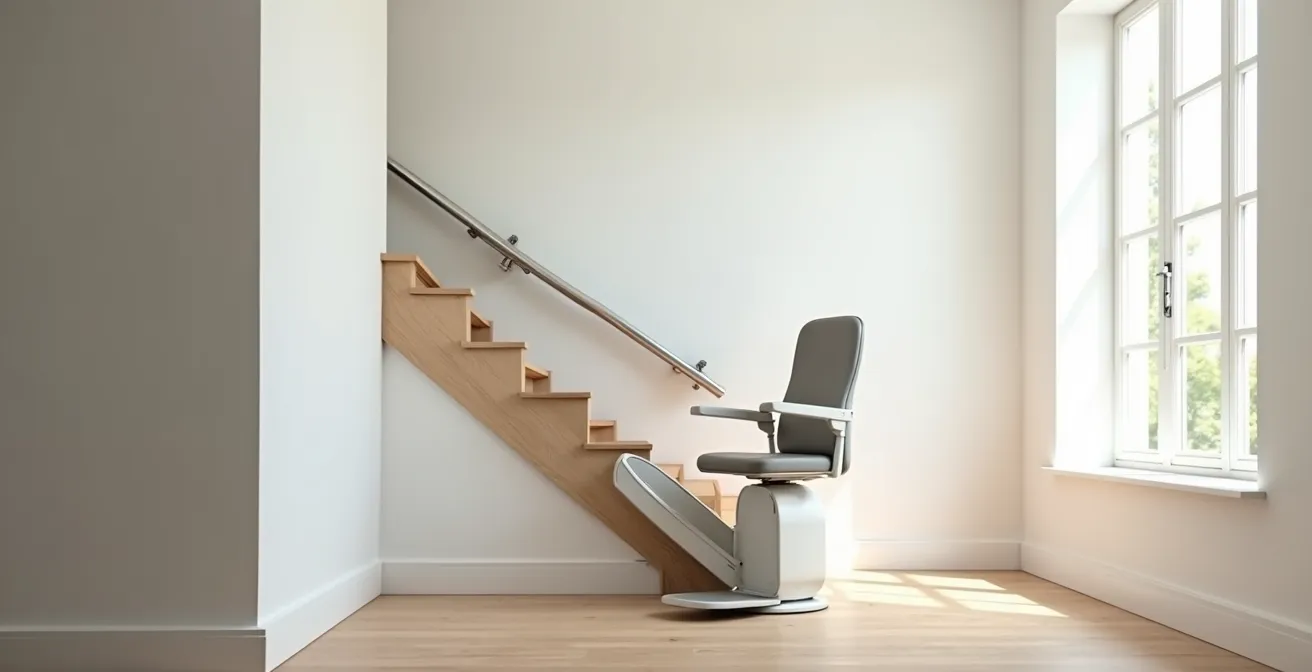
A manual or powered swivel seat allows the user to rotate the chair at the top landing, so they are facing away from the staircase before they stand up. This simple rotation creates a safe “dismount protocol,” effectively blocking the open stairway and allowing the user to step safely onto the solid floor of the landing. For users with cognitive impairment or balance issues, a powered or automatic swivel seat is an essential feature, as it performs this critical safety turn without user intervention. The Access BDD Engineering Team highlights this integration:
Our Advanced Swivel and Leveling technology allows the stair lift to rotate and remain perfectly level while in motion. The stair lift can keep you in the safest and most comfortable position by rotating. The footrest is linked to the seat and swivels together, ensuring your legs remain natural and comfortable.
– Access BDD Engineering Team, Flow X Stair Lift Technical Specifications
Safety features should be chosen based on the user’s specific medical needs. As the table below shows, what is a convenience for one person may be an essential safety component for another. For example, a person with severe arthritis benefits from an ergonomic joystick that requires minimal grip strength, while someone with vertigo needs the stability of a powered swivel to prevent dizziness during the turn. This is where a stairlift becomes a piece of personalized medical equipment.
| Medical Condition | Essential Safety Feature | Why It Matters |
|---|---|---|
| Severe Arthritis | Ergonomic joystick or body-paddle control | Reduces grip strength requirement |
| Cognitive Impairment | Auto-swivel seat | Prevents user error during dismount |
| Peripheral Neuropathy | Larger, sensitive footrest sensor | Detects obstacles despite reduced sensation |
| Vertigo/Balance Issues | Powered swivel seat | Turns user away from fall hazard |
| Anxiety/Panic Prone | Soft-start/soft-stop technology | Prevents lurching motion |
Used Stairlifts: Why They Are Hard to Sell Second-Hand?
When investing in a significant piece of home equipment, it’s natural to consider its future value. With stairlifts, a stark line exists between straight and curved models when it comes to resale. A used straight stairlift retains some value precisely because its components are standardized. The rail can be cut down and re-used in another home, and the chair unit is universal. While depreciation is steep, you can typically recover a portion of your investment, as they can be resold for professional refurbishment.
The story is entirely different for curved stairlifts. As established, the rail of a curved unit is custom-fabricated to the exact dimensions of a single, specific staircase. It is a one-of-a-kind object. The probability of finding another home with an identical staircase configuration—the same turns, landings, and angles—is practically zero. Consequently, the custom rail, which represents the bulk of the system’s cost, has no resale value. It cannot be modified, repurposed, or installed elsewhere. When a curved stairlift is removed, the rail is simply scrap metal.
This reality is a crucial factor in the initial purchase decision. A curved stairlift should be viewed as a permanent home modification, not a transferable asset. While the chair unit itself might be salvaged, the most expensive component is worthless on the second-hand market. This is why few companies deal in used curved stairlifts; the logistics and costs of trying to match a used rail to a new home are prohibitive. Understanding this financial endpoint from the outset frames the purchase as an investment in safety and quality of life, rather than an asset with residual value.
Why 90% of Hip Fractures Are Caused by Indoor Falls?
The decision to install a stairlift is often accelerated by a near-miss or a growing fear of falling. This fear is not unfounded; it is a rational response to a significant and well-documented health risk. Falls are the leading cause of fatal and non-fatal injuries among older adults, and the staircase is one of the most hazardous areas in any home. The statistics from the Centers for Disease Control and Prevention (CDC) are sobering: falls are a primary factor in a staggering percentage of serious injuries.
According to extensive public health data, falls are a major contributor to devastating outcomes. For instance, 83% of hip fracture deaths and 88% of emergency visits for this injury among older adults are directly related to a fall. Each year, over 300,000 older adults are hospitalized for hip fractures, and the majority of these incidents occur indoors. A hip fracture is not a minor event; it is a life-altering injury that often marks the beginning of a sharp decline in mobility and independence, frequently leading to the need for long-term care.
Viewing a stairlift through this lens transforms it from a convenience into a critical piece of preventative medical equipment. It is a form of risk mitigation engineering designed to eliminate the single most dangerous daily activity for someone with declining mobility. The cost and effort of installation must be weighed against the immense physical, emotional, and financial cost of a debilitating fall. By creating a safe and controlled method for navigating floors, a stairlift directly addresses the root cause of a vast number of serious indoor injuries, helping to preserve not just mobility, but overall health and longevity.
When to Request a DEXA Scan: Guidelines for Men and Women Over 65
Understanding the risk of a fall is one part of the equation; understanding your body’s specific vulnerability to fracture is the other. For adults over 65, one of the most important proactive health screenings is a DEXA (Dual-Energy X-ray Absorptiometry) scan. This simple, non-invasive test measures bone mineral density and is the gold standard for diagnosing osteopenia (low bone mass) and osteoporosis (brittle bones). The results of a DEXA scan provide a crucial piece of data for your home safety planning.
A DEXA scan generates a “T-score,” which compares your bone density to that of a healthy young adult. This score is a direct indicator of your fracture risk. A T-score above -1.0 is considered normal. A score between -1.0 and -2.5 indicates osteopenia, and a score below -2.5 signifies osteoporosis. Knowing your T-score allows you to move from abstract fear to a concrete, data-driven action plan. It quantifies your personal risk, making decisions about home modifications like a stairlift less of an emotional choice and more of a logical necessity.
If your T-score indicates osteopenia, it’s a clear warning sign. This is the time to be proactive about fall prevention, including the serious consideration of a stairlift if stairs are a challenge. If the diagnosis is osteoporosis, a fall on the stairs poses a catastrophic risk. At this stage, a stairlift should be considered a non-negotiable safety priority. Discussing your DEXA results with your physician can help create a comprehensive plan that includes medical treatment, vitamin D supplementation, and a home safety strategy. The scan empowers you to make informed decisions about your environment based on the specific structural integrity of your own body.
Key Takeaways
- A curved stairlift is a custom-engineered solution for a single staircase and has no resale value, unlike standardized straight lifts.
- Modern stairlifts attach to the stair treads, not the walls, eliminating the need for most structural home modifications.
- Safety features like swivel seats and specialized controls should be matched to the user’s specific medical conditions to prevent falls.
How to Widen a Doorway Without Moving Load-Bearing Walls?
A stairlift solves the problem of vertical movement, but true home mobility requires a complete, unobstructed “mobility pathway.” This means being able to move freely not just up and down stairs, but also through hallways and doorways. A narrow doorway can be just as much of a barrier as a staircase, especially for individuals using walkers or wheelchairs. Before undertaking major renovations, there are several simple, low-cost modifications that can significantly improve accessibility throughout your home.
The first step is a thorough assessment of your daily routes. Can a downstairs room be converted into a primary bedroom to reduce the need for upstairs travel? If not, measure every doorway along the path to and from the stairlift. For doorways that are only slightly too narrow, one of the most effective and inexpensive solutions is to install offset hinges (also known as swing-clear hinges). These special hinges swing the door completely clear of the doorframe, adding up to two inches of usable clearance for under $50. In some cases, simply removing a non-essential door, like the one to a living room or dining room, can be the easiest solution.
Case Study: The Engineering Solution for Extreme Narrowness
For staircases themselves, modern engineering offers remarkable solutions. The Flow X stairlift, for example, is renowned for its ability to navigate extremely tight spaces. It can be installed on staircases as narrow as 61cm (approx. 24 inches). This is possible thanks to its patented ASL (Advanced Swivel and Leveling) technology, which allows the chair and footrest to rotate during travel, enabling it to move sideways through the narrowest sections of the staircase. This demonstrates how specialized engineering can overcome severe architectural limitations without home modification.
Thinking about the entire mobility pathway ensures that the investment in a stairlift is not undermined by other barriers in the home. The following checklist can guide you through a systematic assessment of your home’s accessibility.
Action Plan: Mobility Pathway Assessment
- Evaluate if a downstairs room can be converted to a primary bedroom to minimize stair use.
- Measure the width of all doorways and hallways along the most-traveled routes in your home.
- Install offset (swing-clear) hinges on key doors to gain up to 2 inches of clearance.
- Consider removing non-essential doors entirely to create wider, open passages.
- Assess landing space at the top and bottom of the stairs to ensure there is enough room for the stairlift to park and for safe transfers.
Frequently Asked Questions on Stairlift Installation
Do I need to reinforce my walls for a stairlift?
In most cases, no. Modern curved and straight stairlifts are engineered to attach directly to your stair treads (the steps themselves), transferring the load through the staircase structure, not the walls. Wall reinforcement is not required for the vast majority of installations.
What if my stairs are made of wood?
Wood, concrete, and metal are all suitable materials for a staircase that will support a stairlift. Installers use different types of brackets and fasteners specifically designed for each material to ensure a secure and stable installation.
Can a stairlift be installed on narrow stairs?
Yes. Advanced stairlift systems are designed specifically for narrow staircases, with some models fitting on stairs as narrow as 24 inches (61cm) wide. Features like chairs that travel sideways allow them to navigate even very tight spaces.
Ultimately, making the right choice is about commissioning a personalized engineering solution for your home. By understanding the core principles of rail design, structural requirements, and personalized safety, you can confidently invest in a system that will provide lasting peace of mind and secure your ability to remain in the home you cherish. Evaluate your needs, assess your home’s unique layout, and choose a solution that delivers not just mobility, but true independence.