In summary:
- The key to vitality after 70 is not separate exercises for body and brain, but an integrated routine where movement directly stimulates cognitive function.
- Sedentary habits actively shrink the brain’s memory center (hippocampus), but targeted exercise can halt or even reverse this decline.
- Start with 5-minute “exercise snacks” throughout the day, incorporating cognitive challenges like counting backward to build a powerful mind-body connection.
- Even after a minor injury, you can maintain strength and prevent frailty by training the uninjured side of your body, a principle known as cross-education.
- Learning complex new skills that engage multiple senses, like cooking or woodworking, builds a stronger cognitive reserve against dementia than simple puzzles.
For many active seniors, the goal isn’t just to live longer, but to live with vibrancy and independence. You may feel a subtle shift—a name that’s just out of reach, or a moment of hesitation on an uneven sidewalk. The common advice is often siloed: do crossword puzzles for your mind, and take walks for your body. While well-intentioned, this approach misses the most powerful biological truth: your brain and body are not two separate entities, but a single, interconnected system.
The conventional wisdom treats physical and mental aging as separate battles to be fought. But what if this is the fundamental mistake? What if the key isn’t just *doing* exercise, but in *how* you exercise? The true breakthrough in maintaining health after 70 lies in a neuro-integrative approach, where every physical movement is intentionally chosen and performed to trigger specific, measurable benefits in brain function. This creates a powerful feedback loop where a stronger body builds a sharper mind, and a sharper mind guides a more capable body.
This guide will move beyond generic advice. We will lay out a science-backed framework for building a dual-action routine that nourishes both your physical and cognitive health simultaneously. We’ll explore why a sedentary lifestyle is so detrimental, how to start safely even with limited mobility, and how to turn every activity into a potent tool for building a resilient, vibrant future.
To help you navigate this integrated approach, this article is structured to build from the foundational science to practical, everyday application. You will find a clear path to creating a routine that truly works for both your brain and body.
Summary: A Neuro-Integrative Routine for Lasting Vitality
- Why Sedentary Habits Accelerate Cognitive Decline Within 6 Months?
- How to Start a 20-Minute Vitality Routine with Limited Mobility?
- Yoga or Tai Chi: Which Practice Better Protects Cognitive Function?
- The Error of Stopping Activity After a Minor Injury That Leads to Frailty
- When to Integrate vitality Exercises: Morning vs Evening Benefits
- Why Learning New Skills Builds a Buffer Against Dementia?
- How to Perform Weight-Bearing Exercises safely with Osteopenia?
- How to Improve Standing Balance to prevent Falls on Uneven Terrain?
Why Sedentary Habits Accelerate Cognitive Decline Within 6 Months?
The phrase “use it or lose it” applies more directly to the brain than we often realize. A sedentary lifestyle is not a neutral state of rest; it is an active process of cognitive decline. Within just six months of reduced activity, the brain begins to show tangible signs of deterioration, particularly in the hippocampus, the region responsible for memory and learning. This isn’t just a vague risk; it’s a measurable physiological change.
The mechanism is twofold. First, physical activity drives blood flow to the brain, delivering essential oxygen and nutrients while clearing away metabolic waste. When we are sedentary, this vital “flushing” process slows, allowing potentially harmful proteins to accumulate. Second, movement stimulates the production of key neurochemicals like Brain-Derived Neurotrophic Factor (BDNF), often called “Miracle-Gro for the brain.” BDNF supports the survival of existing neurons and encourages the growth of new ones. Less movement means less BDNF, and a brain that is less able to repair and rebuild itself.
The consequences are startlingly swift. Scientific studies have shown that inactivity is a significant factor in cognitive aging, as research shows a 1.4% to 1.43% decline in hippocampal volume occurs in sedentary adults over just one year. However, the good news is that this process is not irreversible. A study following seniors for six months found that high-intensity interval training (HIIT) not only prevented age-related decreases in hippocampal volume but also improved its functional connectivity, directly linking physical effort to enhanced brain structure and cognitive ability.
How to Start a 20-Minute Vitality Routine with Limited Mobility?
The idea of a “20-minute workout” can feel daunting, especially if you’re dealing with joint pain, stiffness, or reduced mobility. The common “all or nothing” mindset is a major barrier to starting. The solution is to reframe the concept entirely: instead of one long session, embrace the power of “exercise snacking.” This involves breaking down your activity into short, manageable 5-minute bursts spread throughout the day.
This approach is not only more achievable but is also highly effective. It keeps your metabolism engaged, improves circulation, and prevents the long periods of sitting that are so detrimental. The key is to start from a safe and stable base, like a sturdy chair. Chair-based exercises are a fantastic way to build strength and confidence without putting stress on your joints. You can begin with simple movements that have a profound impact on your daily function and stability.
This image illustrates a perfect starting point: using a resistance band while seated. This simple tool allows you to build upper body and core strength safely, which is essential for posture and balance.
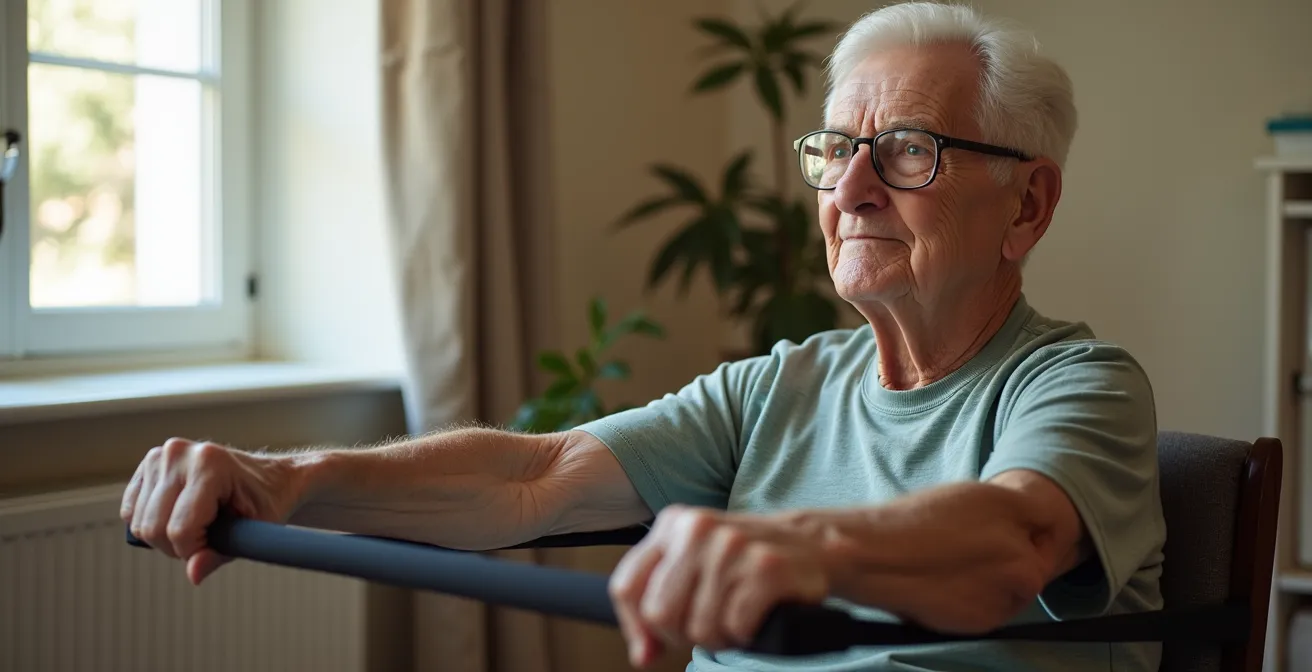
From here, you can gradually progress. Start with seated heel and toe raises to activate the muscles in your lower legs, which act as a “second heart” to pump blood back to your chest. Add seated marching with arm swings to get your heart rate up. As you feel stronger, progress to sit-to-stand exercises, focusing on using your leg and core muscles rather than your arms. Most importantly, weave in a cognitive challenge: while marching in place, count backward from 100 by threes, or name all the green objects in the room. This is the essence of a neuro-integrative routine: training the body and brain as one.
Yoga or Tai Chi: Which Practice Better Protects Cognitive Function?
When considering mind-body practices for cognitive health, yoga and Tai Chi are often mentioned in the same breath. Both are excellent choices, but they protect and enhance cognitive function through slightly different, complementary mechanisms. Choosing between them isn’t about finding a “winner,” but about understanding which practice’s unique cognitive demands best align with your personal goals.
Yoga excels at cultivating focused attention and interoception—the awareness of your body’s internal state. The practice of holding a pose (asana) for an extended period is not just a physical challenge; it’s a mental one. It forces you to focus on your breath, the alignment of your body, and the sensations in your muscles. This sustained focus is a powerful workout for the prefrontal cortex, the brain’s executive control center. It strengthens your ability to filter out distractions and maintain concentration, a skill that often wanes with age.
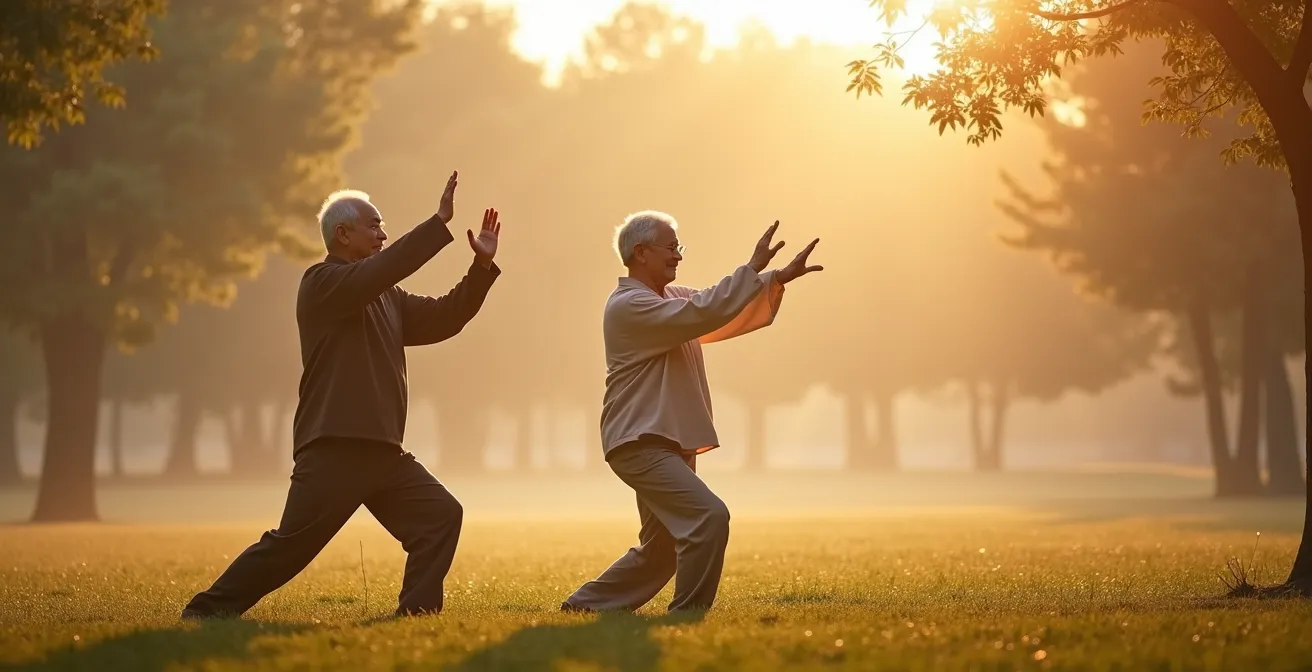
Tai Chi, on the other hand, is a masterclass in procedural memory and dynamic balance. It involves learning and performing a series of slow, flowing, interconnected movements. Recalling and executing these complex sequences is a potent stimulus for the parts of the brain responsible for motor learning and memory. Furthermore, the constant, gentle shifting of weight and the multi-directional movements provide continuous, low-level challenges to your balance system. This trains the brain to better integrate sensory information from your eyes, inner ears, and joints, leading to improved stability and a reduced risk of falls.
Ultimately, the “better” practice is the one you will do consistently. If you are looking to improve your ability to concentrate and manage stress, the meditative stillness of yoga might be more beneficial. If your primary goal is to enhance balance and motor coordination, the fluid movements of Tai Chi might be a better fit. Both are superb examples of a neuro-integrative activity, deeply weaving together physical action and cognitive engagement.
The Error of Stopping Activity After a Minor Injury That Leads to Frailty
A minor sprain, a sore back, or a tweaked knee can feel like a major setback, often leading to the most common—and most detrimental—piece of advice: “Just rest and stop all activity.” While acute pain should never be ignored, complete cessation of movement is a critical error that can initiate a rapid downward spiral into frailty. The body deconditions quickly; muscle mass and cardiovascular fitness begin to decline within days, making it that much harder to return to your previous level of function.
This is where a science-backed, motivating mindset is crucial. Instead of thinking “I can’t do anything,” the question should be, “What *can* I do?” The answer lies in the fascinating principle of cross-education. Your brain isn’t strictly divided into left and right hemispheres for movement control; there’s significant crossover. This means that by training the uninjured side of your body, you can maintain a surprising amount of strength in the injured, immobilized limb. Research shows that this type of contralateral training can result in an 8-12% absolute strength gain in the untrained limb, effectively fighting off muscle atrophy while you recover.
Furthermore, recovery is an ideal time to focus on the purely mental side of the cognitive-motor link. The practice of movement visualization—mentally rehearsing an activity with vivid detail, as if you were actually doing it—activates the same neural pathways in the brain as the physical action itself. This mental practice keeps those connections strong and primed for when you can physically move again.

By focusing on what you *can* do—training the other side of your body, engaging in movement visualization, and performing gentle, non-painful range of motion exercises—you transform recovery from a passive waiting period into an active, strategic process. This proactive approach is the single biggest factor in preventing a minor injury from becoming a long-term catalyst for frailty.
When to Integrate vitality Exercises: Morning vs Evening Benefits
The best time to exercise is, quite simply, the time you’ll actually do it. However, by understanding your body’s natural daily rhythms, or chronotype, you can strategically time your activities to amplify their benefits for both body and brain. It’s not about forcing yourself into a rigid schedule, but about working *with* your biology, not against it. Think of it as aligning your vitality routine with your internal clock for maximum impact.
Morning exercise, for example, can be particularly powerful for cognitive function. Your body’s level of cortisol (the “alertness” hormone) naturally peaks in the morning. Engaging in gentle aerobic activity during this time can leverage that natural spike to significantly enhance your executive function—the brain’s ability to plan, focus, and multitask—for the rest of the day. A brisk walk after breakfast does more than just burn calories; it sharpens your mind.
As the day progresses, your body temperature rises, and your muscles become more pliable. This makes mid-morning or early afternoon an optimal window for activities that require more strength, power, or coordination. Your reaction times also tend to peak in the afternoon, making it an ideal period to practice balance exercises that challenge your stability. In the evening, the focus should shift towards unwinding and preparing the body for sleep. Gentle stretching or slow, mindful practices like Tai Chi can help lower cortisol, boost circulation, and release tension, promoting a more restful night’s sleep, which is itself crucial for cognitive health and memory consolidation.
Your Action Plan: Chronotype-Based Exercise Timing
- Morning (6-10 AM): Leverage your natural cortisol spike. Engage in gentle aerobic exercise like a brisk walk to enhance executive function and mental clarity for the day.
- Mid-morning (10 AM-12 PM): Your body temperature is rising. This is an optimal time for strength training with resistance bands or light weights, as muscles are more efficient.
- Afternoon (2-4 PM): Reaction times and coordination peak. This is the best window for balance and skill-based exercises, such as Tai Chi or specific balance drills.
- Evening (5-7 PM): Prepare for rest. Focus on gentle stretching, mobility work, or slow Tai Chi to boost circulation and calm the nervous system before sleep.
- Identify your chronotype: For one week, track your energy, focus, and mood in a simple journal. Note when you feel most energetic and when you feel a slump. Use this personal data to find your optimal exercise window.
Why Learning New Skills Builds a Buffer Against Dementia?
While puzzles and games are beneficial, building a truly resilient brain—a brain with a strong “cognitive reserve”—requires more than simple mental stimulation. Cognitive reserve is like a neurological savings account; it’s the brain’s ability to withstand age-related changes or pathology without showing signs of impairment. The most effective way to build this reserve is not by repeating familiar tasks, but by learning complex new skills that challenge the brain in novel ways.
When you learn something new, like a musical instrument, a new language, or a craft, you force your brain to build new neural pathways and strengthen connections between different regions. This process, known as neuroplasticity, is the physical basis of cognitive reserve. A brain with a dense network of connections has more alternative routes to bypass any “roadblocks” caused by aging or disease. A study by the Human Care NY Research Team highlights this protective effect:
A study conducted on elderly adults aged 70 or older found that those who participated in activities like playing games, using a computer, making crafts, or participating in social activities were about 20 to 30 percent less likely to develop mild cognitive impairment (MCI) compared to those who engaged in these activities less frequently
– Human Care NY Research Team, 10 Best Brain Exercises for Seniors
The key word is “complex.” Activities that engage multiple senses and require planning, judgment, and fine motor control are particularly potent brain-builders. They provide a richer, more holistic workout for your brain than a single-domain exercise like a crossword puzzle.
Case Study: The Cognitive Power of Complex Sensorimotor Skills
Activities like taking a cooking class or learning woodworking offer profound cognitive benefits. Cooking, for instance, engages all five senses, requiring you to plan steps, measure ingredients accurately, and make judgments about taste and texture. It’s a real-world problem-solving task that boosts confidence and self-sufficiency. Similarly, creative pursuits like drawing, knitting, or scrapbooking demand more brainpower than simple learning exercises. They force you to flex your mental muscles in planning, spatial reasoning, and fine motor execution, all while providing the enjoyment and social connection that are also vital for brain health.
How to Perform Weight-Bearing Exercises safely with Osteopenia?
Receiving a diagnosis of osteopenia—a condition of lower-than-average bone density—can be frightening. It often leads people to avoid impact and weight-bearing activities for fear of fracture. However, this is precisely the wrong approach. Bones, like muscles, are living tissue that responds to stress. The right kind of stress, applied safely and progressively, is exactly what they need to become stronger. The key is to provide a mechanical signal without overwhelming the skeletal system.
You don’t need to lift heavy weights or engage in high-impact jumping. The process can start very gently. One of the safest and most effective introductory exercises is the simple heel drop. By rising onto your toes and then dropping your heels firmly to the ground, you send a small, targeted shockwave up through your legs and into your hips, signaling your bone-building cells (osteoblasts) to get to work. As you gain confidence, you can progress to brisk walking, focusing on making deliberate, firm foot strikes with each step.
Resistance bands are an excellent tool for those with osteopenia. They allow you to create tension and challenge your muscles—which in turn pull on your bones and stimulate them—without the spinal compression that can sometimes be a concern with free weights. The goal is consistency over intensity. Research indicates that a commitment to consistent exercise is what yields results; one study found that a total of 52 hours of exercise over time is associated with improved cognitive and physical performance in older adults. A safe and effective protocol would be performing 3 sets of 10-15 repetitions for each chosen exercise, about 3 times per week, always listening to your body and monitoring for any joint discomfort.
Key Takeaways
- Your brain and body are a single system; the most effective health strategy integrates physical movement with cognitive challenges.
- Complete rest after a minor injury is a mistake; active recovery, including training the uninjured side and movement visualization, prevents frailty.
- The best way to build a buffer against cognitive decline is by learning complex, new skills that engage multiple senses, not just repeating simple puzzles.
How to Improve Standing Balance to prevent Falls on Uneven Terrain?
Good balance is not a passive state; it’s an active skill that requires constant communication between your brain, your inner ear, your eyes, and the nerves in your joints and feet (proprioception). As we age, this system can become less efficient, which is why falls become a greater risk, especially on unpredictable surfaces like a grassy lawn, a gravel path, or a cracked sidewalk. The key to preventing these falls is not to avoid uneven terrain, but to actively and safely train your balance system to handle it.
Training for real-world balance means moving beyond simply standing on one leg on a flat floor. You must progressively introduce small, controlled challenges that mimic the unpredictability of the outdoors. This is known as sensory perturbation. You can start by disrupting your visual input—try balancing on a firm surface with your eyes closed. This forces your brain to rely more heavily on information from your inner ear and the soles of your feet, strengthening those pathways.
The next step is to add a cognitive load, which is a core part of the neuro-integrative approach. The real world is full of distractions. By practicing a cognitive-motor drill, like standing on one leg while counting backward from 100 by threes, you train your brain to maintain balance even when your attention is divided. Here are some progressive exercises to build a robust balance system:
- Clock-Reach Exercise: Stand on one leg and imagine you are at the center of a large clock on the floor. Keeping your balance, reach your other foot to tap the “12,” then the “3,” “6,” and “9” positions. This improves dynamic balance and hip mobility.
- Sensory Disruption Drill: As mentioned, practice balancing on a firm surface first with your eyes open, then with them closed. Hold for 30 seconds. This enhances proprioception.
- Cognitive-Motor Drill: Stand on one leg while performing a mental task, such as reciting the alphabet backward or naming state capitals.
- Uneven Surface Progression: Once comfortable on a firm floor, progress to standing on a balance pad, a folded yoga mat, or a firm cushion. This directly simulates real-world terrain and fine-tunes your ankle stability.
The CDC’s recommendation of practicing balance exercises at least three times a week is a solid guideline. By incorporating these progressive drills for 10-15 minutes daily, you’re not just practicing balance; you are actively re-wiring your brain to be more resilient, responsive, and ready for whatever the path ahead holds.
Your journey to enhanced vitality starts not with a giant leap, but with a single, intentional step. Choose one exercise or one new skill from this guide and commit to trying it this week. The power to build a more resilient mind and body is already within you; all it takes is the decision to begin.