
The transition to a power wheelchair isn’t about loss; it’s a strategic upgrade to amplify your personal autonomy.
- It expands your “energy budget,” letting you choose how to spend your vitality on activities that matter.
- Mastering the practical details—from battery life to home modifications—is the key to building confidence and control.
Recommendation: Start by documenting your daily mobility challenges. This simple act is the first step in building a clear case for this empowering tool and reframing your mindset.
The conversation often starts with a quiet, persistent ache. It’s the fatigue that cuts a shopping trip short, the fear of a fall on uneven pavement, or the simple, frustrating fact that your world has started to shrink. When a doctor or loved one first mentions a power wheelchair, the internal monologue can be brutal. For many, it feels less like a solution and more like a surrender—a final admission that you’ve “given up” on walking, on independence, on the person you used to be.
Well-meaning advice to “focus on the positive” or that “it’s just a tool” often falls flat because it dismisses the profound emotional weight of this transition. This isn’t just about getting from point A to point B; it’s about your identity. But what if the entire framework is wrong? What if a power wheelchair isn’t a symbol of defeat, but a tactical upgrade? This guide is built on a different premise: viewing powered mobility not as a replacement for your legs, but as an Autonomy Amplifier—a sophisticated tool you choose to wield to reclaim your energy, your environment, and your engagement with life.
This isn’t about ignoring the challenges. It’s about facing them with a new strategy. We will break down the practical hurdles that create anxiety—battery life, home modifications, travel, and navigating insurance—and transform them into a clear, manageable plan. By mastering the mechanics, you will build the confidence to embrace the profound psychological freedom that follows. This is your guide to gearing up, not giving in.
To help you navigate this journey, this article covers the key practical and strategic considerations. The following sections provide a clear roadmap for mastering your new tool and mindset, turning potential anxieties into areas of confident control.
Summary: A Guide to Navigating the Psychological Shift to a Power Wheelchair
- How to Calculate Battery Needs for a Full Day of Activity?
- Door Widening and Ramps: The Hidden Costs of Power Chairs
- Joystick vs Keypad: Which Control Suits Tremorous Hands?
- The Risk of Airline Damage: Protecting Your Chair on Flights
- Medicare Criteria: Proving “In-Home Necessity” for Coverage
- 5-Foot Turn Circle: Is Your Hallway Dead-Ending Your Mobility?
- How to Document Daily Struggles Before the Evaluator Arrives?
- How to Identify Hidden Tripping Hazards in “Open Concept” Homes?
How to Calculate Battery Needs for a Full Day of Activity?
One of the first anxieties new users face is “range anxiety”—the fear of being stranded with a dead battery. This is where the mindset shift begins. Instead of worrying, you can become a master of your “energy budget.” Think of your chair’s battery not as a limitation, but as a predictable resource you can manage. Your daily physical energy is finite; a power chair dramatically expands that budget, and learning to manage its battery is the first step toward unlocking that potential.
Start by understanding the basics. Most power chair batteries are designed to last a full day of typical use, but “typical” varies. Factors like your weight, the terrain you cover (hills can drain a battery twice as fast), and even the temperature affect performance. A study found the median battery lifespan is 22.3 months, so tracking your battery’s health from day one is a smart strategy. Creating a simple charging log can help you notice when it starts holding less of a charge, giving you plenty of time to plan for a replacement.
The key to confidence is routine. Experts from an NHS study on power wheelchair usage recommend charging the battery every single night for at least eight hours, even if you only used it for a short trip. This ensures you start every day with a full “energy budget.” Consider your daily plans: a quiet day at home requires less power than an afternoon at the park with grandchildren. Over time, you’ll develop an intuitive sense of your chair’s range, turning anxiety into a simple, predictable part of your daily planning.
Door Widening and Ramps: The Hidden Costs of Power Chairs
The transition to a power wheelchair extends beyond the user; it involves adapting your environment. The fear of “hidden costs” for home modifications is a significant source of stress, but demystifying these expenses is the first step toward taking control. Framing this not as a burden, but as an investment in environmental mastery, is key. These changes aren’t just about access; they’re about making your home a seamless extension of your newfound autonomy, free from barriers and frustration.
The most common modifications are ramps and wider doorways. While costs can seem daunting, having clear data helps. For example, reports show the average cost to make a home wheelchair accessible is $4,348. This number can fluctuate wildly based on your needs and location, but it provides a realistic starting point for planning. It’s also important to remember that many simple, effective changes—like rearranging furniture to create wider pathways—cost nothing at all and can dramatically improve your home’s flow.
Understanding your options is crucial for budgeting and making smart choices. A permanent concrete ramp is a long-term, durable solution, while a modular aluminum ramp might be a more flexible, and sometimes more affordable, option. The table below breaks down the typical costs and characteristics of common modifications.
| Modification Type | Cost Range | Durability |
|---|---|---|
| Wooden Ramp | $1,000-$2,800 | Weather-prone, customizable |
| Aluminum Ramp | $1,500-$3,000 | Durable, low maintenance |
| Concrete Ramp | $2,000-$6,000 | Long-lasting, expensive |
| Door Widening | $500-$2,500 | Permanent modification |
Remember to investigate local and national grants, veterans’ programs, and non-profits that may offer financial assistance for these modifications. Approaching this as a project to upgrade your home for lifelong independence can transform a source of anxiety into an empowering act of future-proofing your living space.
Joystick vs Keypad: Which Control Suits Tremorous Hands?
A primary concern for individuals with conditions like Parkinson’s or essential tremor is controllability. “What if my hands shake too much to drive it safely?” This fear is valid, but it’s based on the misconception of a one-size-fits-all machine. The reality is that a modern power wheelchair is an incredibly sophisticated and customizable device. It’s not about you conforming to the chair; it’s about programming the chair to respond perfectly to you. This is the essence of the Autonomy Amplifier: technology tailored to your unique body.
The most common control is the joystick, but it’s far from the only option. For those with significant tremors, a standard joystick can be frustrating. However, today’s electronics offer powerful solutions. According to mobility experts, simple programming adjustments can be the difference between a client driving safely or not. Technicians can program “tremor dampening” settings that filter out unintentional movements, allowing for a smooth, controlled ride. They can also adjust the speed and acceleration, ensuring the chair never feels too fast or jerky.
The key is to work closely with your supplier and therapist. They can assess your specific needs and fine-tune the controls. This might mean trying different types of joystick handles—like a large ball or a T-bar—that are easier to grip. In some cases, alternative control systems like head arrays, sip-and-puff systems, or even keypad controls might be more suitable. Your ability to control the chair is the gateway to independence, and technology is on your side.

Seeing your hand on the control, and feeling the chair respond smoothly to your commands, is a profoundly empowering moment. It replaces the fear of losing control with the tangible reality of gaining it. Don’t be afraid to advocate for your needs during the evaluation process. Insist on trying different settings and options until you find the perfect fit. This customization is what turns a piece of equipment into a true extension of your will.
The Risk of Airline Damage: Protecting Your Chair on Flights
For many, the dream of renewed mobility includes travel—visiting family, exploring new places, or simply not being left behind. But this dream is often met with the nightmare scenario of arriving at your destination to find your expensive, life-sustaining wheelchair damaged by an airline. While the risk is real, it is also manageable. Taking a strategic, proactive approach to air travel can greatly mitigate these risks and keep your world from shrinking.
First, let’s look at the data to get perspective. While horror stories abound, statistics show that the frequency of wheelchair damage by airlines decreased to 1.26% in the first quarter of 2024. This means that while damage is unacceptably common, the overwhelming majority of chairs arrive safely. Knowing this can help shift your mindset from one of inevitable disaster to one of calculated risk management. Your job is to do everything in your power to make sure your chair is in the 98.74%.
Protection begins long before you get to the airport. Your wheelchair is a complex piece of medical equipment, and ground crews may not be trained to handle it. You must become the expert and provide clear, simple instructions. This is not the time to be shy; it’s a time for assertive self-advocacy. By following a clear pre-flight protocol, you can significantly reduce the chances of damage and ensure you have recourse if the worst happens.
Your Pre-Flight Protection Checklist: Safeguarding Your Mobility
- Take detailed photos and videos of your wheelchair from multiple angles before you leave home, documenting its condition.
- Create a simple, laminated instruction sheet with pictures showing key information: where to push, where not to lift, and how to disengage the motors for freewheel mode.
- Clearly label the battery type (e.g., “Non-Spillable Gel Cell”) and attach battery specifications to the chair. You can even print the airline’s own regulations for your battery type to preempt any confusion.
- Upon arrival, inspect your chair *before* leaving the gate area. If there’s damage, go immediately to the airline’s baggage service office and file a report. Do not leave the airport without a written claim.
- Know your rights. Under the Air Carrier Access Act in the U.S., airlines are required to repair or replace a damaged wheelchair to its original condition, without regard to standard luggage liability limits.
Traveling with a power chair requires extra planning, but it is far from impossible. By preparing meticulously, you are not just protecting a piece of equipment; you are protecting your freedom to move through the world.
Medicare Criteria: Proving “In-Home Necessity” for Coverage
Navigating the requirements for Medicare coverage can feel like a daunting, bureaucratic maze. The key phrase you will encounter is “in-home necessity.” This is often where the psychological disconnect happens. You might be thinking about getting a power chair to go to the grocery store or the park, but Medicare’s primary concern is your ability to function *inside your home*. Understanding this distinction is crucial for a successful evaluation and for reframing the purpose of the chair in a way that aligns with their criteria.
The goal is to demonstrate that without a power wheelchair, you are unable to safely and efficiently perform your Mobility-Related Activities of Daily Living (MRADLs). This is a specific term that includes essential tasks like toileting, feeding, dressing, grooming, and bathing. You must prove that you cannot use a cane or walker, and that you lack the upper body strength to self-propel a manual wheelchair effectively throughout the day to accomplish these tasks. This is where your documentation becomes your most powerful tool of advocacy.
Your therapist and physician will lead the formal evaluation, but your input is vital. They need concrete evidence of your struggles. Instead of saying “I get tired,” you need to provide specific examples like, “After I walk to the kitchen to get breakfast, I am too exhausted to stand at the sink and wash my plate.” This detailed, functional description is what an evaluator needs to justify the medical necessity of the device. The goal is to paint a clear picture of how your mobility limitations compromise your ability to live safely and independently within your own home.
Action Plan: Your Medicare Documentation Checklist
- Document MRADL Failures: For one week, keep a log of every time you were unable to complete a task like getting a meal or using the bathroom because of fatigue, pain, or fear of falling.
- Create an Activity Log: Note specific in-home mobility challenges. For example, “Could not carry laundry from the bedroom to the washer (30 feet) without stopping twice due to shortness of breath.”
- Secure Physician Support: Your doctor must provide documentation of the medical condition that necessitates the chair. Ensure their notes clearly link your diagnosis to your functional limitations.
- Measure Your World: Record distances within your home. “The distance from my bed to the bathroom is 40 feet. I can only make this trip once without needing to rest for 15 minutes.”
- Prepare Your Narrative: Before the evaluation, rehearse clear, factual descriptions of your limitations. Use the language of function, not just feeling. “I am unable to…” is more powerful than “It’s hard for me to…”
This process may feel clinical, but it is the most effective path to getting the equipment you need. By strategically documenting your reality, you are building an undeniable case for an essential tool that will restore your in-home autonomy.
5-Foot Turn Circle: Is Your Hallway Dead-Ending Your Mobility?
Once you’ve mastered the personal and financial aspects of your new chair, the final frontier is your own home. A common, and deeply frustrating, experience is getting your new power chair home only to discover it can’t make the tight turn from the hallway into the bathroom. This is where the technical specifications of a chair, like its turning radius, meet the reality of your living space. But this isn’t a dead end; it’s a spatial puzzle that you can solve.
Most power chairs, especially front-wheel or rear-wheel drive models, require a significant amount of space to turn a corner, often needing a clear circle of up to 5 feet in diameter. Mid-wheel drive chairs are famously more nimble, capable of turning 360 degrees within their own footprint, making them a superior choice for smaller, older homes. If you haven’t yet selected a chair, discussing your home’s layout—especially narrow hallways and tight corners—with your therapist is absolutely critical. This is a key part of ensuring your environmental mastery.
But what if you already have your chair and are facing these challenges? Don’t despair. Before considering expensive modifications like widening a door, look for simpler solutions. As one home optimization study notes, one of the best no-cost upgrades is strategic furniture rearrangement. Can you move a bookshelf or a console table that’s pinching a hallway? Can you create wider, more direct “pathways” through open-plan living areas?
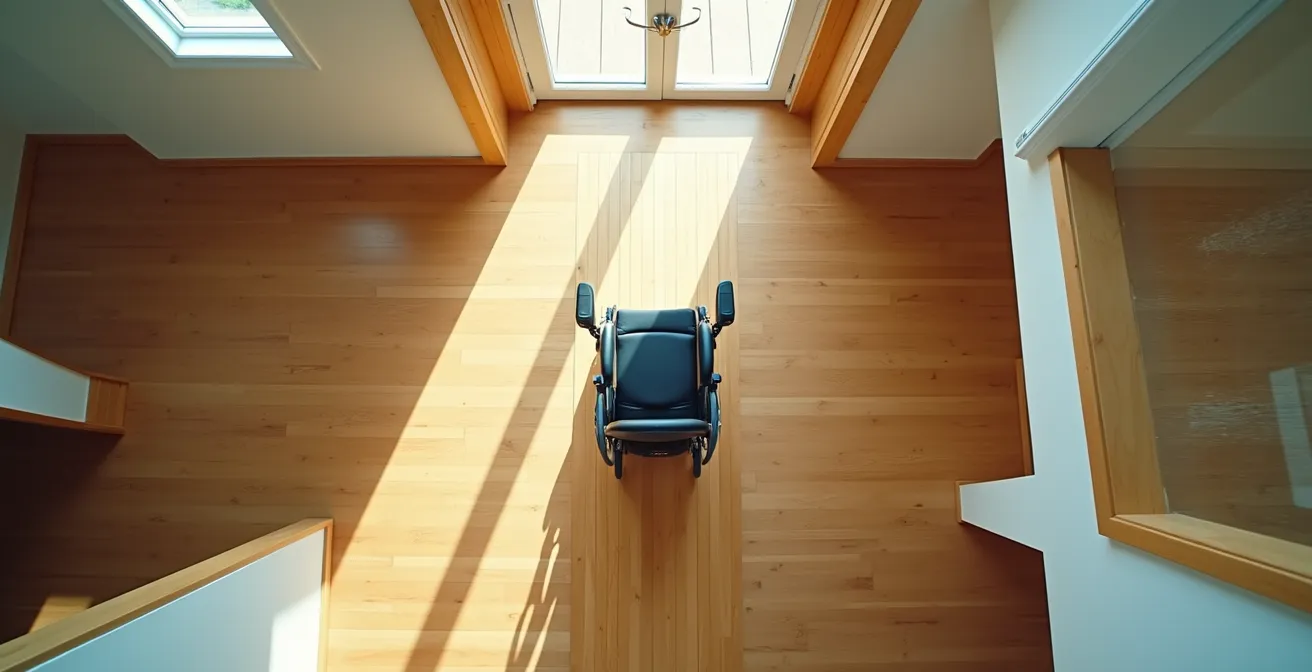
Sometimes it’s not about the turn itself, but the approach. Practicing a three-point turn, much like you would in a car, can often allow you to navigate a corner that seems impossible at first. Approach the turn as wide as possible, then back up to adjust your angle before completing the maneuver. It takes practice, but mastering these small driving skills within your home is a huge confidence booster. It’s another example of how you can adapt and out-think challenges, reinforcing your role as the skilled operator of your mobility tool.
How to Document Daily Struggles Before the Evaluator Arrives?
The period before your formal mobility evaluation is the most critical time for self-advocacy. An evaluator will only see a snapshot of your life, typically on a “good day” when you’re rested. It is your responsibility to provide the data that tells the full story. This isn’t about exaggerating; it’s about accurately and systematically documenting the reality of your “energy budget” and how your mobility limitations impact your daily life. This documentation is the evidence that proves the necessity of an Autonomy Amplifier.
Your goal is to shift from vague descriptions to precise data. Instead of saying, “I’m tired all the time,” create an energy log. On a scale of 1 to 10, rate your energy level when you wake up, after you get dressed, after you prepare a meal, and so on. Note the “energy cost” of each activity. This creates a powerful visual of how quickly your energy is depleted by basic mobility. Document every near-miss and every instance where you chose not to do something—like get a glass of water—because the effort was too great.
Use specific, powerful language. “Attempting to walk to the mailbox consistently leads to a level of exhaustion that requires a two-hour rest period” is infinitely more impactful than “It’s hard to get the mail.” This process of documentation does more than just build your case for insurance; it’s an act of empowerment in itself. It validates your experience and moves you from a place of feeling helpless to one of strategic action. As one mobility guide wisely states:
Knowledge is power, so educate yourself about your rights and the resources available to you. As you take charge, you’ll also start to feel less helpless and more empowered.
– Redman Power Chair Medical Team, Coping with Mental Illness in a Wheelchair Guide
This documentation becomes your voice in the evaluation process. It ensures that the decision is based on the full picture of your daily reality, not just a ten-minute observation. It is the first, most crucial step in taking control of your mobility journey.
Key Takeaways
- Viewing a power wheelchair as an “Autonomy Amplifier” rather than a symbol of defeat is the crucial first step.
- Mastering the practical aspects—battery management, home layout, and travel prep—is the foundation of confidence.
- Strategic documentation of your daily struggles (MRADLs) is your most powerful tool for navigating insurance criteria like Medicare.
How to Identify Hidden Tripping Hazards in “Open Concept” Homes?
Even in a modern, “open concept” home that seems spacious, a host of hidden hazards can disrupt your mobility and threaten your safety. For a power wheelchair user, the landscape is different. Small thresholds between rooms, the edge of an area rug, or a stray charging cord can become significant obstacles. Achieving true environmental mastery means learning to see your home from a new perspective: wheel-level. This final step is about fine-tuning your space to create a truly safe and effortless environment.
The most effective way to start is to literally get down on the floor and look at your home from the height of your chair’s footplates. You’ll be amazed at what you notice. That small, quarter-inch lip on the transition strip to the bathroom? It’s a jolt every time you cross it. The beautiful but thick area rug in the living room? Its edge is a potential tipping hazard. Identifying these issues is the first step. For major level changes, solutions like installing non-slip flooring can be a worthwhile investment, though installing non-slip flooring to prevent falls typically costs $1,000-$5,000. However, many powerful fixes are much cheaper.
For area rugs, the simplest solution is often to remove them entirely. If you love them, securing all edges with heavy-duty, double-sided rug tape is a non-negotiable safety measure. Map out your most frequent routes—from the bed to the kitchen, from the living room to the door—and ensure these “soft corridors” are always free of clutter. This includes small furniture, pet toys, and especially electrical cords. A systematic hazard assessment transforms your home from a potential obstacle course into your secure base of operations, the place where your autonomy is absolute.
By proactively identifying and mitigating these small but significant hazards, you complete the process of adapting your environment. This isn’t just about preventing falls; it’s about creating a seamless flow that allows you to move through your home with confidence and ease, conserving your physical and mental energy for the things that truly matter.
Ultimately, embracing powered mobility is a declaration of intent. It’s the decision to prioritize engagement over exhaustion, to choose access over isolation, and to strategically invest in a tool that expands your world. Begin today by starting your mobility log. This simple act of documentation is your first step on the path to not just accepting a new reality, but actively shaping it to your will.